Orthodontics

Braces and clear aligners: the right treatment plan matters more than the fastest one

Straightening teeth is not simply a matter of fitting an appliance. Age, gum health, bone structure and what you actually want changed all differ from person to person, so two mouths that look alike on a photograph can need completely different treatment plans. This page sets out what a first orthodontic assessment involves, how braces and clear aligners really compare, the limits and risks of moving teeth, and why the retainer at the end is not optional.

Why choose Home Dental's orthodontic team?

  • Specialist orthodontists in residence — specialist registration can be verified directly on the Dental Council of Hong Kong's specialist register
  • Orthodontic assessment uses standard diagnostic records: intraoral scans, panoramic (OPG) and cephalometric X-rays
  • 31 general and specialist dentists collaborating across disciplines — gum, restorative and wisdom-tooth issues can be assessed in the same visit before treatment begins
  • Formal quotations itemise appliances, review visits and retainer arrangements, avoiding unexpected charges mid-treatment
  • Orthodontic treatment available at both Causeway Bay and Tsuen Wan centres

Six questions we are asked most, answered up front

How long does treatment take?Usually 12 to 24 months. Complex cases can take longer.
Will I need teeth taken out?Not necessarily. It depends on crowding, arch space, facial profile and your bite goals, and cannot be judged from a photograph or a price list.
Braces or clear aligners?Both are ways of delivering force to teeth. The choice follows an examination of your gums, roots, bite and jaw relationship, and what you want improved.
Am I too old for braces?No. Provided the gums, roots and supporting bone are suitable, adults achieve good results routinely.
When should a child be seen?A first assessment at around age 7. Being assessed does not mean starting treatment then.
What does it cost?Orthodontic treatment from HK$30,000, depending on complexity.

Not sure which of these describes you? WhatsApp us to book, or Call 3956 9387.

What happens at a first orthodontic assessment

Many people put off booking because they do not know what they are walking into, or worry they will be sold something on the spot. A first orthodontic assessment normally covers five things:

  1. Understanding what you most want to change, whether that is appearance or function;
  2. Examining tooth alignment, the bite, the gums and the relationship between the upper and lower jaws;
  3. Taking orthodontic diagnostic records: intra-oral and facial photographs, an intra-oral scan, plus a panoramic radiograph (OPG) and a lateral cephalometric radiograph. Both radiographs are standard for orthodontic assessment, since they show root position, unerupted teeth and the front-to-back and vertical relationship of the jaws;
  4. An initial explanation of fixed braces, clear aligners, whether extractions are likely, and any other workable options;
  5. The expected treatment duration, the main risks, and the fee range.
Some complex cases need the records and radiographs analysed before a formal treatment plan can be given. Where that applies we say so at the visit itself, rather than letting you expect a final plan the same day.

Why the treatment plan has to be built around you

It is easy to assume orthodontics means wearing an appliance, so the cheapest appliance will do. In practice, a plan that has not properly accounted for gum health, root and bone condition and the bite raises the risk of the treatment drifting off course and of complications. A responsible plan assesses the following first:

What is assessedWhy it matters
Age and skeletal growthThe movements available to an adult differ from those available to a growing teenager
Gum and periodontal healthMoving teeth while the gums are unstable accelerates gum recession
Root and bone conditionDetermines how far a tooth can safely be moved
Bite functionBeyond straight teeth, the upper and lower teeth have to meet in a stable, working bite
Records and imagingUsed to assess roots, supporting bone, unerupted teeth and jaw relationship, and to set a pre-treatment baseline
Your own goalsExpectations differ, and the plan has to be designed around what you want
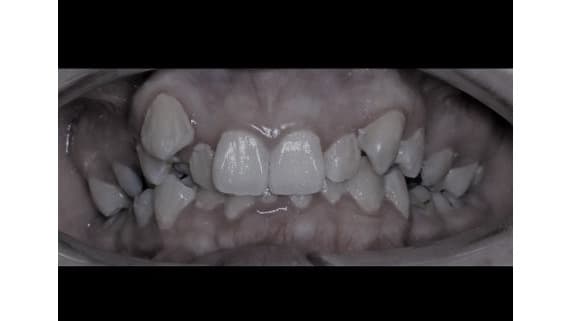
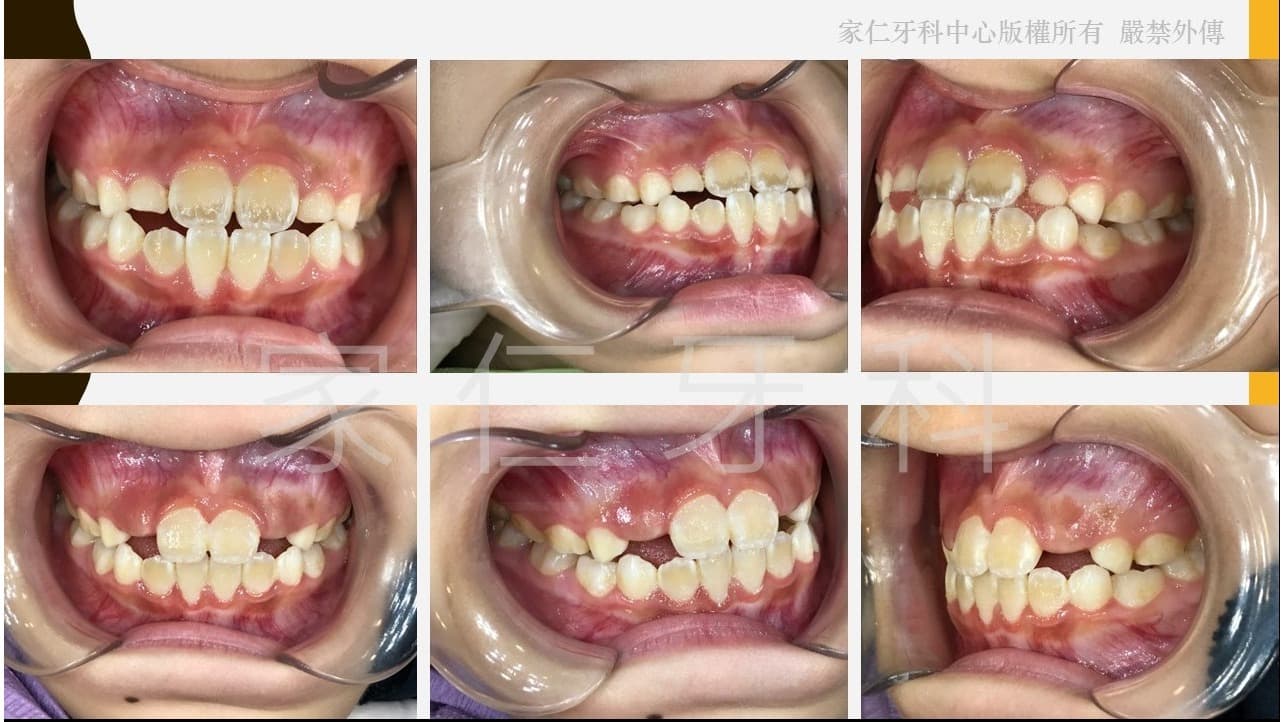
Pre-treatment intra-oral photograph of an adult case showing crowded, irregular front teeth
Pre-treatment intra-oral record: crowded and irregular teeth. Cases that look similar can have different causes and need different treatment plans. Individual cases vary.

Fixed braces or clear aligners

Both are tools for delivering force to teeth. Neither one determines the outcome; the treatment plan does. Where they genuinely differ is in daily use:

Fixed bracesClear aligners
ControlMore direct, and better suited to complex movementsSome complex movements need attachments, elastics or a combined approach
Depends on youBonded to the teeth, so there is nothing to remember to wearNeeds long daily wear; results depend heavily on hours worn
AppearanceMore visibleLess visible
Cleaning and eatingHarder to clean aroundRemovable for cleaning, and easier to eat with
Both can be the right tool. The question is not which one is more advanced, but which one is better suited to finishing your treatment plan. That judgement follows a clinical examination, rather than choosing a brand first and making the case fit it.

Want to know which would suit your case? WhatsApp us to book, or Call 3956 9387.

Related reading:

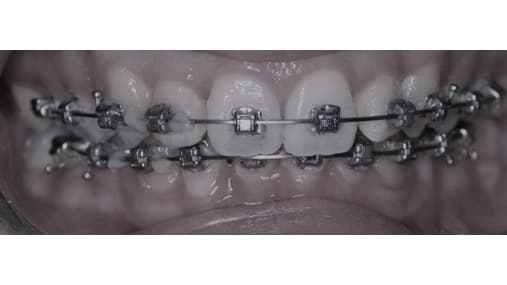
Intra-oral photograph during orthodontic treatment showing an archwire guiding tooth movement
Treatment in progress: the archwire guides teeth into position step by step, and every step should be one the plan anticipated. Individual cases vary.

How teeth actually move, and why it takes this long

Teeth are not fixed rigidly into bone. Routine cases can first be assessed by the general dental team at Home Dental Centre. Where clinical needs indicate further care in this area, Dr. David K. Leung (Specialist in Orthodontics), Dr. Richard Ho (Dentist) and Dr. Wilson Man (Dentist) at the centre provide the relevant treatment; the treating dentist is arranged according to clinical needs and the dentists on duty. Where a case involves more than one area of dentistry, dentists from different areas at the centre can jointly develop a combined treatment plan, without the patient needing a referral elsewhere. An appliance applies light, continuous force; the bone around the tooth remodels, resorbing on one side and forming on the other, and the tooth migrates through bone towards its planned position.

Because this is a biological process that depends on bone remodelling step by step, there is a safe rate of movement. More force does not mean faster:

  1. Excessive force or movement that is too rapid does not shorten treatment. It raises the risk of complications.
  2. Properly run treatment therefore takes time, generally 12 to 24 months depending on the case.
  3. Speed is the wrong first criterion for choosing a treatment plan. Suitability is the right one.

What do you most want improved? Different goals mean different plans

There is no single standard for appearance. Some people care most about the front teeth being straight, some about the profile, and some only want to chew properly. So the most important step before treatment starts is stating the goal clearly. Where the goal stays vague, treatment can run smoothly and still not match what you had in mind.

  1. Often, simply improving alignment achieves the appearance you were after, without committing to more complex, higher-risk movements.
  2. Conversely, forcing high-risk movements in pursuit of a maximal change, such as over-expanding the arch or over-retracting the front teeth, can cost you gum recession or root resorption, neither of which is reversible.
  3. Doing less, safely and stably, often serves you better over time. The clinician's job is not to push for the largest possible change, but to work with you to balance appearance, function, stability and risk.

Limits and risks: some movements should not be forced

Being clear about what cannot be done matters as much as explaining what can.
  1. Arch expansion in adults is limited. In children and adolescents the mid-palatal suture has not fully closed, so an appliance can achieve genuine skeletal expansion. In adults the suture is usually more mature, so a conventional tooth-borne expander achieves comparatively little skeletal widening, and part of the change may come mainly from teeth tipping outwards, which relapses easily and increases the risk of gum recession. Where a larger skeletal change is needed, bone-anchored expansion or a surgical approach may have to be considered; whether either is feasible depends on age, skeletal pattern and gum condition.
  2. There is a limit to how far teeth can move. Moving teeth too far or too quickly can cause gum recession and root resorption, in which roots become shorter, and rarely the tooth's nerve can lose vitality. These are not reversible.
  3. Adults can still achieve very good results, but the plan has to be built differently: tighter goals, more conservative movement and closer monitoring.
None of this means braces are unsafe. Most cases complete uneventfully given accurate diagnosis, sensible force levels, good cleaning and regular monitoring. The point is that the plan has to respect each person's biological limits.
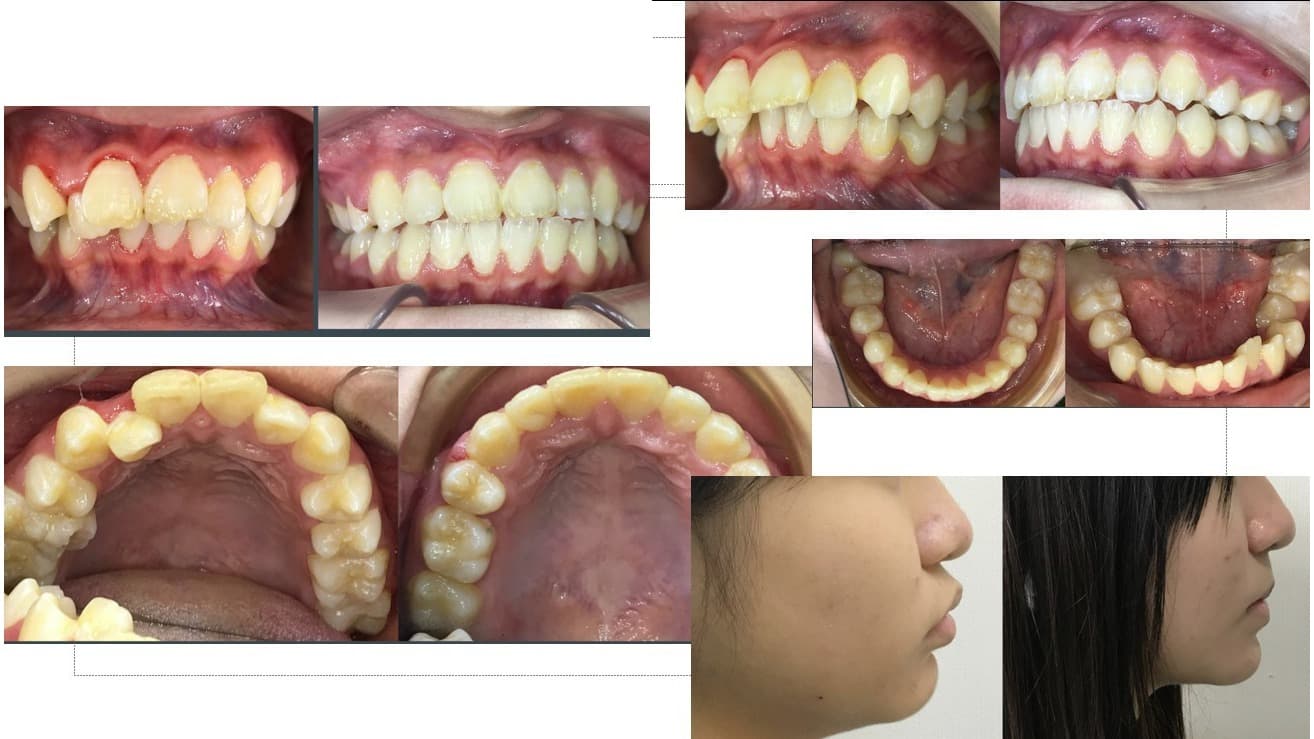
Clinical records of an adult fixed appliance case, including multiple intra-oral views and a profile view
Records from an adult fixed appliance case treated with mini-screw anchorage, including multiple intra-oral and profile views. Individual cases vary.
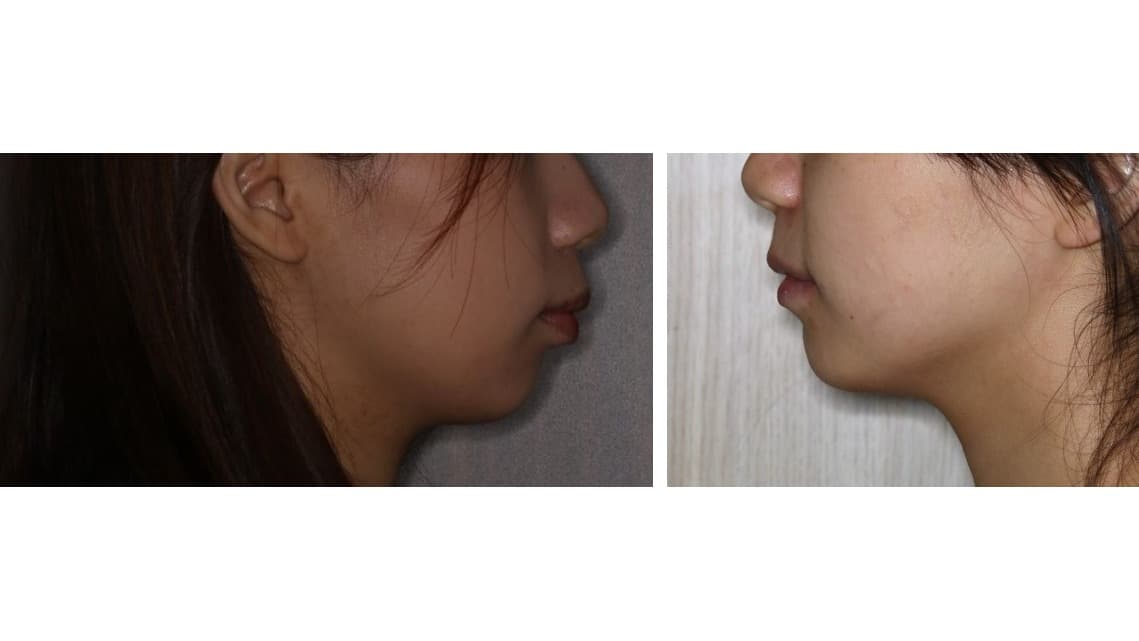
Facial profile records of an adult orthodontic case before and after treatment (left: before, right: after)
Facial profile records before and after treatment (left: before, right: after). Individual cases vary, not every case shows the same degree of change, and this does not indicate that another case would achieve the same result.

Regular review visits, so drift is caught early

Orthodontics is a dynamic process running over one to two years. Teeth do not always respond exactly as first predicted, which is why treatment needs continuous monitoring and adjustment as it goes.

  1. Reviews are generally every four to eight weeks, with progress checked against the treatment plan.
  2. Adjusting force, wear pattern or appliance as soon as drift is spotted is usually easier than dealing with it late in treatment, and reduces the chance of replanning or extending the case.
  3. Movement that is too fast and movement that is too slow are both problems: too fast can damage roots and the periodontium, too slow points to a problem with force levels or with wear.
  4. Repeatedly missing reviews, or abandoning treatment part-way, drags the case out and leaves alignment and bite unfinished, sometimes with gum or root problems that were avoidable. If treatment has been interrupted, it should be reassessed by a Specialist in Orthodontics as soon as possible rather than simply stopping wear or discarding the appliance.

Debonding is not the finish line: retainers decide whether the result holds

After treatment, teeth tend to drift back towards where they started. That is the natural behaviour of periodontal fibres and bite forces, not a sign that treatment was done badly. The retainer's job is to hold teeth in their new position while the surrounding tissues settle.

  1. Retainers may be removable, or a wire bonded behind the teeth, and are chosen to suit your case. Sometimes both are used.
  2. How and how long they are worn depends on the case: usually more intensively at first, then tapering.
  3. If wear stops altogether, teeth can gradually relapse. Crowding returning to the lower front teeth is the most common pattern.
  4. Retainers can break, distort or get lost. Contact the clinic to have one replaced as soon as that happens, rather than waiting for the next review.
Our formal quotation states whether retainers are included in the treatment fee, and what a replacement costs, so there is no unexpected charge once treatment finishes.

Children: what Phase I early treatment actually is

Treating children is not the same as treating adults, because a child's skeleton is still growing, and that is a window adults do not have. A first orthodontic assessment at around age 7 is generally advised. That does not mean treatment starts at 7; it means a clinician can judge whether anything needs early intervention.

What Phase I commonly addresses

  • Crossbite: the upper and lower teeth meet the wrong way round, which affects jaw development if left.
  • Habits: thumb sucking, tongue thrusting and similar habits that affect how the arches develop.
  • Severe crowding or lack of space: managing space early to guide adult teeth into position.
  • Growth guidance for skeletal problems (growth modification): depending on the problem, this may involve a functional appliance, an expander, or headgear (an extra-oral traction appliance), used during the growth period to guide the upper and lower jaws into a more favourable position and reduce the chance of needing more complex treatment, or even orthognathic surgery, later on. This is not available once growth is complete.
But Phase I is not needed by every child. Most children do not need early intervention, and a full assessment once the adult teeth are through is sufficient. Treating early when it is not needed simply adds a burden for the child. Whether Phase I is indicated has to be a clinical judgement, and that is exactly the point of the age 7 assessment: intervene early where it helps, and simply monitor where it does not.
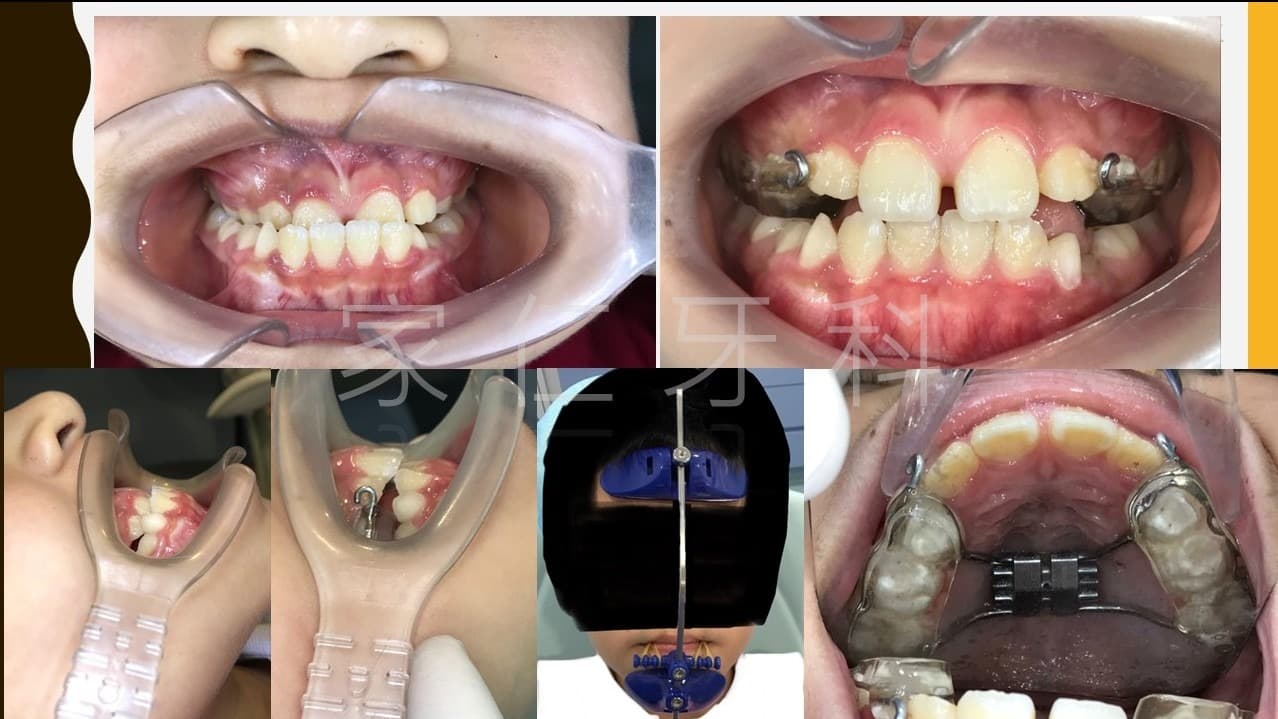
Intra-oral clinical record of a child with a crossbite
Clinical record of a child with a crossbite. Addressing a crossbite early helps avoid asymmetric jaw development. Individual cases vary.
Clinical record of early orthodontic treatment in a child, showing an intra-oral expander and headgear
Phase I growth modification record: an intra-oral expander used with headgear (extra-oral traction) to guide the direction of jaw growth. Which appliance is appropriate is a clinical decision, and not every skeletal problem is suitable. Individual cases vary.

How to verify a Specialist in Orthodontics in Hong Kong yourself

Only a dentist listed under the Orthodontics category of the Specialist Register maintained by the Dental Council of Hong Kong may hold themselves out as a Specialist in Orthodontics. Specialists must complete accredited specialist training and the associated professional assessments before being entered on the register.

You can check this yourself rather than relying on what a clinic tells you:

  1. Go to the Dental Council of Hong Kong website and open the Specialist Register.
  2. Search the dentist's name under the Orthodontics category.
  3. A dentist not listed there cannot describe themselves as a Specialist in Orthodontics, however experienced they may be clinically.

It takes about a minute, and it is the easiest and most useful check you will make in the whole process.

Orthodontic fees

An orthodontic assessment requires both a panoramic (OPG) and a lateral cephalometric radiograph. These are charged separately and are not alternatives to one another. Orthodontic treatment starts from HK$30,000. What you pay depends mainly on how complex the case is, how long it runs, which appliances are needed, and whether other treatment has to be combined with it, rather than on the brand of appliance. An accurate quotation follows a clinical assessment by a Specialist in Orthodontics.

ItemFee
General consultation (including emergencies)HK$180
Paediatric consultationHK$400
Orthodontic specialist consultationHK$400 – 1,500 (by case complexity)
Panoramic radiograph (OPG)HK$400
Lateral cephalometric radiographHK$400
Orthodontic treatmentFrom HK$30,000
The formal quotation sets out the appliances, the expected treatment range, the review schedule, and whether retainers and other items are included, so that no unexpected charge appears once treatment has started.

Want to know roughly where your case sits? WhatsApp us to book, or Call 3956 9387.

Book an orthodontic assessment

Want to know whether fixed braces or clear aligners suit you, whether extractions are likely, and roughly what the treatment and the fees will involve? At an orthodontic assessment we start with what you want improved, then explain the workable options, the limits and the risks against your gum, root, bite and skeletal condition, so you can decide before anything begins.

Share

FAQ

Frequently Asked Questions

  • How much do braces cost in Hong Kong?

    Orthodontic treatment starts from HK$30,000. What you pay depends mainly on case complexity, treatment duration and the appliances needed, rather than the brand of appliance. Outcomes turn on diagnosis and planning — the extraction decision, control of root movement and the finishing detail of the bite determine stability and retention afterwards. Before comparing quotes, confirm whether refinements, reviews and retainers are included. Home Dental has general dentists and Specialists in Orthodontics, arranged by case complexity and your preference; an accurate fee follows clinical assessment.

  • How much does orthodontic treatment cost?

    Orthodontic treatment starts from HK$30,000, covering both invisible aligners and traditional metal braces. A general consultation is HK$180; treatment is quoted after the assessment. The final cost depends on your specific dental condition and the complexity of your case, which our orthodontist will determine during your initial examination.

  • How long does orthodontic treatment typically take?

    Treatment duration varies depending on the complexity of your case and the type of braces chosen. Mild to moderate cases with invisible aligners may take less time, while complex cases requiring traditional metal braces often need longer correction periods. Your orthodontist will provide a personalised timeline after assessing your teeth during the initial consultation.

  • How long does orthodontic treatment take?

    Generally 12 to 24 months, depending on how complex the alignment and bite are. Mild cases can finish within a year; complex cases take longer. Attending reviews and wearing the appliance as instructed also affect the total time.

  • What's the difference between invisible aligners and traditional metal braces?

    Invisible aligners are nearly transparent, removable for easy cleaning, and suitable for mild to moderate tooth misalignment. Traditional metal braces offer stronger orthodontic force for complex cases, provide long-lasting stability, and are fixed throughout treatment. Our orthodontist will recommend the most suitable option based on your specific dental condition.

  • Do I have to have teeth extracted for braces?

    Not necessarily. Whether extractions are needed depends on how crowded the teeth are, tooth size, space in the arch, the facial profile, and the gum and bite goals. Some cases gain space through measured expansion, interproximal reduction or other means; in other cases, avoiding extractions can push the teeth too far forwards. The options and their trade-offs should be explained to you, rather than assumed one way or the other in advance.

  • Can I claim orthodontic treatment from my insurance?

    We do not offer direct billing with insurers, but we provide official receipts and treatment records so you can claim from your insurer directly. Coverage varies by policy, so please confirm with your insurer.

  • Do braces hurt?

    Teeth are usually tender for a few days after an appliance is fitted and after each adjustment, and the bite can feel odd, but this generally settles. Contact the clinic if you have persistent severe pain, noticeable swelling, an appliance cutting into the soft tissue, or a tooth that becomes unusually loose.

  • What are the risks of orthodontic treatment?

    The common and manageable ones are early tenderness and the fact that cleaning becomes harder, which raises the risk of decay and gum inflammation. The risks tied to how the case is planned are gum recession and root resorption, and rarely loss of nerve vitality in a tooth. A suitable treatment plan, regular reviews and good oral hygiene are the three things that keep those risks down.

  • Will orthodontic treatment be painful?

    Most patients experience some pressure or mild discomfort when braces are first fitted or adjusted, as teeth begin to move into new positions. This sensation typically eases within a few days. Your orthodontist will discuss what to expect and recommend ways to manage any discomfort. A proper clinical assessment is essential to understand your individual experience.

  • How often will I need follow-up appointments?

    Regular follow-up appointments are scheduled throughout your orthodontic treatment. During these visits, our orthodontist tracks your progress and adjusts your braces or aligners as needed to ensure the best possible results. The frequency depends on your treatment plan and will be discussed during your initial consultation.

  • Can an adult have their dental arch expanded?

    A degree of arch expansion is possible, but it is important to distinguish moving teeth from genuine skeletal widening. In adults the suture is usually more mature, so conventional expansion achieves comparatively little skeletally. Where a larger increase is needed, bone-anchored expansion or a surgical option may have to be considered. The safe range is judged from your skeletal pattern, gum condition and bite.

  • Is there an age limit for braces?

    There is no single upper age limit. What matters is whether the gums, roots, supporting bone and general health are suitable. Adults usually still achieve good results, though the goals, the extent of movement and the way treatment is monitored may differ from a teenager's.

  • How often are review visits during treatment?

    Generally every four to eight weeks, set by the clinician according to the appliance and progress. The purpose is to check the teeth against the treatment plan so that any drift is picked up and corrected early. Movement that is too fast and movement that is too slow both need addressing.

  • Do I need to wear a retainer after treatment?

    Yes. Teeth tend to drift after treatment, and the retainer is an important part of holding the result. How and how long it is worn is set case by case. If wear stops altogether, teeth can gradually relapse. Contact the clinic to have a retainer replaced if it breaks, distorts or is lost.

  • What happens if orthodontic treatment is interrupted?

    Interrupted treatment leaves the teeth part-way, with neither alignment nor bite finished, and over time can produce gum or root problems that were avoidable. It should be reassessed by a Specialist in Orthodontics as soon as possible, so that a decision can be made about resuming, adjusting or replanning, rather than simply stopping wear or discarding the appliance.

  • How do I check whether a dentist is a Specialist in Orthodontics?

    Go to the Dental Council of Hong Kong website, open the Specialist Register, and search the dentist's name under the Orthodontics category. A dentist not listed there cannot describe themselves as a Specialist in Orthodontics, however experienced they may be clinically. The check takes about a minute.

  • At what age should a child have a first orthodontic assessment?

    Around age 7 is generally advised. That does not mean treatment begins at 7; it allows a clinician to judge whether a crossbite, a habit, severe crowding or a skeletal problem needs early intervention. Most children do not need Phase I treatment, and a full assessment once the adult teeth are through is sufficient.

Still wondering about something? Our team is happy to chat.

This page has been reviewed by the Content Review Committee of Home Dental Centre. The Committee comprises members of our Board of Directors, legal advisors, and relevant professionals, and regularly re-reviews the page to meet Hong Kong dental service standards.

Reminder: You have the right to choose a Hong Kong dentist based on your individual needs. We recommend referring to the list of registered dentists published on the official website of the Dental Council of Hong Kong to make a choice best suited to your personal needs. The above content is intended to give you a brief introduction to the nature and effects of the relevant dental procedures, so that you can make informed decisions when choosing a dentist and related treatment options. All treatments have advantages and disadvantages — the key is that you must have a basic understanding of different treatments and procedures and be aware of the associated risks. The above content does not represent the professional opinion or views of any dentist or dental institution. For the sake of your health, please consult your family dentist for formal medical advice.

This content is originally produced by Home Dental, all rights reserved. Unauthorized reproduction, modification, or publication is prohibited. Violators will bear legal responsibility. For citation or partnership inquiries, please contact our center for written permission.

Last updated: Aug 2026