Orthognathic surgery (corrective jaw surgery) addresses problems of jaw position, proportion and skeletal bite alignment — for example anteroposterior or vertical discrepancies of the upper or lower jaw, a skeletal underbite, an open bite, or jaw asymmetry. Not all bite or facial profile concerns require surgery: many cases can be managed with orthodontics alone. At Home Dental Centre, an oral and maxillofacial surgeon and a specialist orthodontist carry out a joint assessment to determine whether the underlying problem lies in the teeth or in the jaw structure before any treatment is recommended. The operation itself moves sections of the upper or lower jaw bone and fixes them in the planned position, and is normally combined with orthodontic treatment. Patients commonly attend because of difficulty biting, concerns about their facial profile, or after being told during an orthodontic consultation that their case involves the jaw bones. This page explains the indications, the treatment pathway, how the cost is made up, and common misconceptions, for anyone considering this treatment.
Is the problem my teeth, or my jaw?
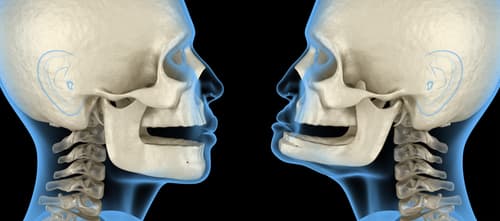
Problems of tooth alignment and problems of jaw structure are treated differently. When the jaws are correctly positioned and only the teeth are poorly aligned, orthodontic treatment alone is usually appropriate. When the position or proportion of the jaw bones themselves is at fault — a skeletal problem — moving the teeth alone may not produce a satisfactory bite, and surgical repositioning of the jaw may need to be considered.
Many patients first describe their concern as an underbite, a crooked chin or facial asymmetry. On examination, some of these cases trace back to jaw position, and others to tooth alignment alone. Common signs of a skeletal problem include:
- A pronounced underbite, with the lower front teeth closing outside the upper front teeth
- Marked protrusion or retrusion of the upper or lower jaw
- Front teeth that do not meet when biting together (open bite)
- A chin that appears tilted or off-centre
- Visible facial asymmetry, with the two sides of the face clearly uneven
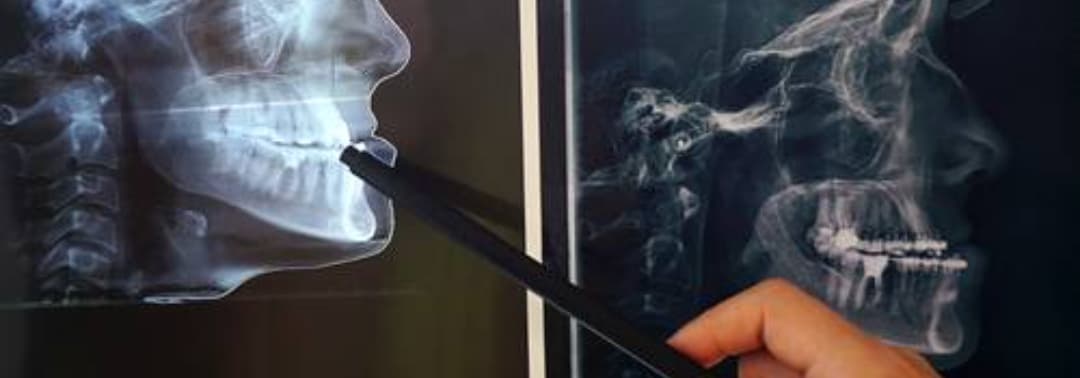
Some cases combine both: the teeth tilt over time to compensate for the jaw position, forming a compensated alignment. In these situations, moving the teeth without addressing the jaw may leave the bite unstable and the change in appearance limited. Determining which category a case falls into requires clinical examination, X-rays and imaging analysis — commonly a lateral cephalometric X-ray (which measures the angles and proportions of the jaws and teeth), bite records and facial proportion analysis. Most patients know clearly what kind of problem they have, and what the options are, once the assessment is complete.
Orthognathic surgery is also normally scheduled after jaw growth is complete, so that continued growth does not affect the surgical result; adolescent cases are first documented and observed before a suitable time for intervention is decided.
What orthognathic surgery addresses
Orthognathic surgery is directed at the jaw structure itself. Common indications include:
- Discrepancies in the position, size or proportion of the upper or lower jaw
- Skeletal underbite (reverse bite), skeletal deep bite, and open bite
- Asymmetric jaw development causing facial asymmetry or affecting bite function
- Difficulty chewing, speaking or closing the lips caused by jaw position
- Selected cases of obstructive sleep apnoea assessed as related to jaw structure
These conditions can occur alone or together. Whether a case is an indication for surgery is established by clinical examination and imaging analysis, considered alongside the practical difficulties the patient experiences with chewing, speech or appearance. Sleep apnoea cases are usually judged together with sleep study results and the opinions of the relevant specialties.
Surgery is not always needed
Many patients who attend for assessment can achieve a reasonable outcome through orthodontics or other non-surgical approaches. Home Dental Centre does not treat surgery as the default option; the purpose of the joint assessment is precisely to distinguish dental problems from skeletal ones and to avoid over-treatment. If the assessment shows that surgery is not required, we will say so and recommend a more suitable approach; some cases only need treatment of individual teeth or other dental work, without embarking on a full orthognathic course.
The treatment pathway
Orthognathic treatment generally runs in five stages, with the exact sequence and content adjusted to the individual case:
- Joint assessment: an oral and maxillofacial surgeon and a specialist orthodontist examine you together, supported by X-rays and imaging analysis, to determine whether the problem lies in the teeth or the jaw structure. This step sets the direction of treatment. If you have already started orthodontic treatment elsewhere, bring the records with you — the assessment builds on your current situation.
- Treatment planning: a plan is drawn up linking the surgical and orthodontic phases, setting out the sequence, goals and arrangements for each stage; in suitable cases, 3D imaging analysis is used to support the planning. The plan is explained before treatment starts, and where more than one workable option exists, the alternatives are set out for you to choose between.
- Pre-surgical orthodontics: a period of orthodontic treatment usually precedes surgery, moving the teeth into positions that match the planned jaw position. During this stage some patients notice the bite temporarily feeling less coordinated — an expected part of the process that the dentist explains in advance. The time required depends on the individual case and is managed by the specialist orthodontist.
- Surgery: performed in a private hospital operating theatre under general anaesthesia, led by the oral and maxillofacial surgeon; most techniques are carried out inside the mouth, so the face is generally left without a visible scar. Hospital stay and recovery arrangements depend on the extent of surgery and individual circumstances, and are set out in the treatment plan; the early diet after discharge is liquid and soft food, adjusted step by step as recovery progresses.
- Post-surgical orthodontics and follow-up: after surgery, you return to the same team to complete the remaining orthodontic treatment and attend regular reviews of long-term bite stability; retention appliances are arranged as needed once the course is complete.
Why is care coordinated by a dental team rather than booked directly with a hospital?
A private hospital provides the operating theatre and the inpatient environment, and the operation itself takes place there. Orthognathic treatment, however, is a process measured in years, and the operation is only the middle step. The initial diagnosis, pre-surgical orthodontics, surgical planning, post-surgical orthodontics and long-term bite follow-up all take place at the dental clinic. At Home Dental Centre, the same team follows the case from the first assessment through to the completion of orthodontic treatment — the oral and maxillofacial surgery and orthodontic specialists collaborate on an ongoing basis, so information is not fragmented across different institutions — while the operation itself is performed in a private hospital operating theatre. The two settings work together.
To give one example: the pace of tooth movement during pre-surgical orthodontics directly affects when the operation can be scheduled, and the fine adjustment of the bite after surgery calls for the surgical and orthodontic specialists to judge together. Coordinating the whole course under one team reduces the loss of information across referrals and keeps the transitions between stages smooth; routine reviews take place at the clinic, without returning to the hospital each time. If questions arise during treatment about the braces, the fixation, or the bite, you contact the clinic directly rather than going through the hospital.
Orthognathic care at Home Dental Centre
- A fixed team built on long-term collaboration between an oral and maxillofacial surgeon and a specialist orthodontist, with clinical records and imaging shared within the team
- The same team follows the case from first assessment to the completion of post-surgical orthodontics, with the handover between stages coordinated internally
- Surgery performed in a private hospital operating theatre under general anaesthesia, led by a specialist, with orthodontics and reviews continuing at the clinic afterwards
- A written treatment plan: after examination and imaging assessment, you receive a written plan setting out the arrangements for each stage, so you and your family can consider it and raise questions
These arrangements cover the whole course from the first assessment to the completion of post-surgical orthodontics; if circumstances change during treatment, the plan is reviewed jointly and updated in writing. A written plan also makes it easier to seek another opinion before deciding.
How is the cost of orthognathic surgery calculated?
Cost is one of the most common questions asked about orthognathic treatment. Because the surgical scope and orthodontic needs differ from case to case, a specific figure can only be given after assessment — but how the cost is made up can be understood in advance. The overall cost of orthognathic treatment is not a single surgical fee but the combination of every part of the course, typically covering: specialist assessment, X-rays and imaging, pre- and post-surgical orthodontics, the surgeon fee, anaesthesia, hospital and operating theatre charges, fixation materials used during surgery, and reviews and post-operative follow-up.
The actual figure varies from case to case, and is mainly affected by:
- Whether one jaw or both jaws are operated on
- The complexity of the surgery
- Hospital and operating theatre arrangements
- Anaesthesia arrangements
- The orthodontic approach used before and after surgery
- The overall length of treatment
Of these components, the orthodontic fees and the surgery-related fees (surgeon, anaesthesia, hospital and operating theatre) are usually calculated separately. Because several parties are involved, a single figure would not reflect how the course is actually arranged; after the joint assessment, the team provides a written treatment plan setting out the arrangements for each component, which also helps with comparison and budgeting.
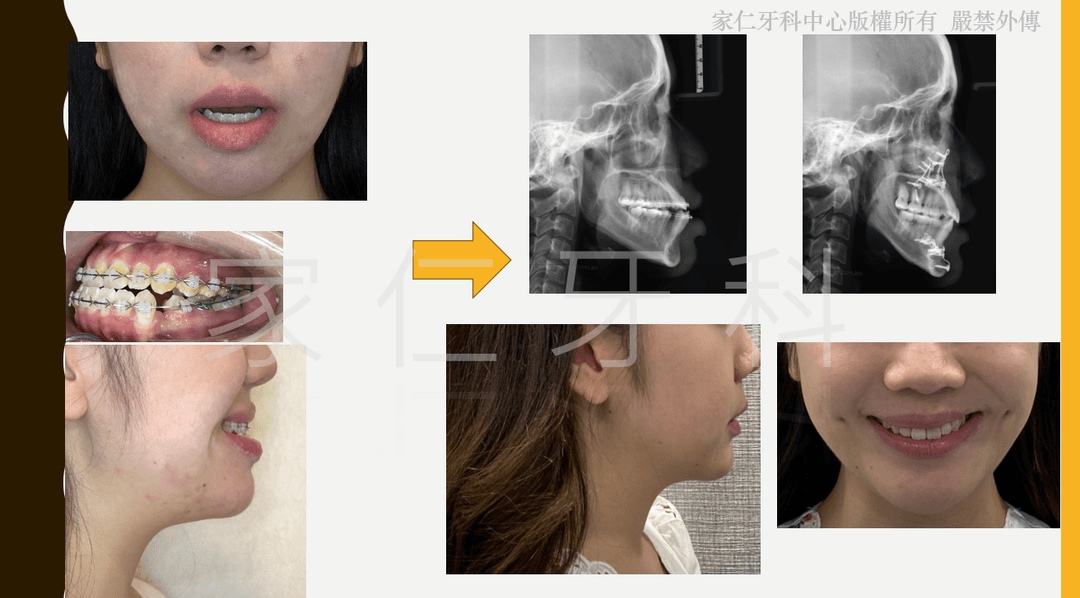
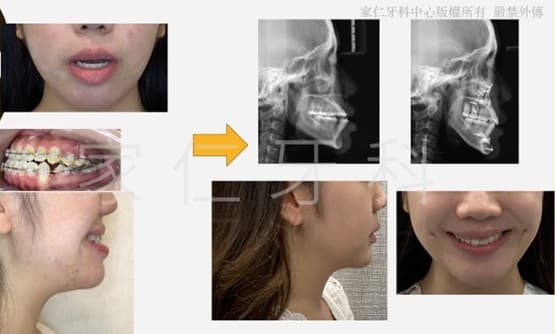
Lateral X-ray imaging records before and after orthognathic surgery treatment (individual case, for illustration only)
Common misconceptions
Misconception 1: orthognathic surgery is only about appearance
It is a functional treatment: the primary goal is to address jaw position and bite function. Changes to the facial profile follow from repositioning the jaw; they are not the starting point of treatment. Function and appearance are related, but the planning and the criteria of assessment are function-led; where the main aim of attending is purely to change appearance, the dentist will say honestly at assessment whether orthognathic surgery is appropriate. Our patient-facing explanation of how orthognathic surgery corrects the bite walks through each stage in plainer terms.
Misconception 2: surgery can replace orthodontics
The two work at different levels — surgery repositions the jaw bones, orthodontics aligns the teeth. Skeletal cases usually need both, staged and coordinated, to reach a stable bite; the sequence and the division of work are fixed at the treatment-planning stage.
Misconception 3: every bite problem needs surgery
Only skeletal problems of the jaw structure call for surgery to be considered; dental problems are generally managed with orthodontics. Even where the signs look similar, the underlying cause can differ, so which category applies must be established by clinical examination and imaging analysis, not by appearance alone.
Misconception 4: the final result is visible immediately after surgery
Swelling is expected at first, and the facial profile and bite take time to settle. Post-surgical orthodontics and regular reviews continue during this period before the state described in the treatment plan is reached; at each review the dentist explains which stage the case has reached. The resolution of swelling and the adaptation of the bite are part of recovery, and the pace varies between individuals.
Misconception 5: older patients cannot have the surgery
Age is not the only consideration. Where oral and general health allow, and after the specialist has assessed bone condition and surgical risk, older patients may still be candidates for orthognathic surgery. Equally, a younger patient whose jaw is still growing may not be suited to immediate surgery.
Book a joint specialist assessment
If you are unsure whether your concern relates to tooth alignment or to jaw structure, book a joint specialist assessment. An oral and maxillofacial surgeon and a specialist orthodontist will assess your case together before any treatment is proposed. An assessment is not a commitment to surgery; understanding the nature of the problem and the workable options is itself of practical value in deciding the next step. If you have previous dental X-rays or orthodontic records, bring them along — they help the dentists understand your situation.
You can make an appointment via:
・The WhatsApp button on this website — contact us instantly
・Call 3956 9387 (during office hours)