LASER DENTISTRY · SOFT-TISSUE CARE

Laser Dentistry: Lower-Risk Soft-Tissue Care Many People Don't Know a Dentist Can Provide

Home Dental Centre uses a soft-tissue diode laser for a range of outpatient procedures. Laser work on soft tissue generally means less bleeding and faster healing — and just as importantly, we will tell you plainly when it is not the right tool.

What is a soft-tissue laser?

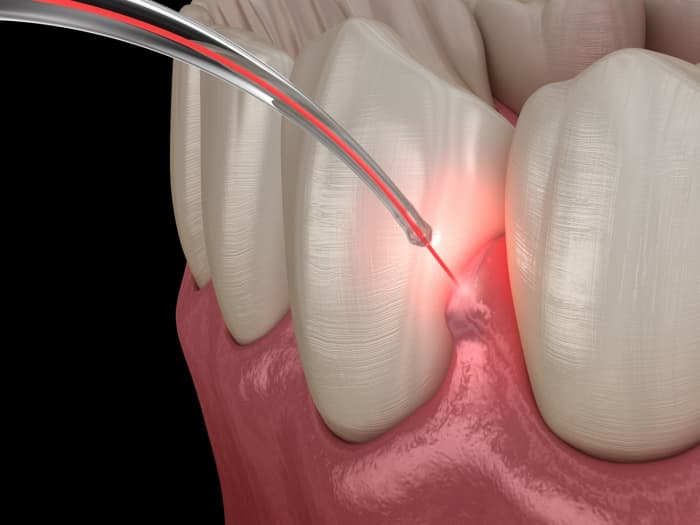
Soft-tissue laser handpiece with a fine fibre tip, used for oral soft-tissue procedures
Soft-tissue laser handpiece with a fine fibre tip, used for oral soft-tissue procedures. Illustrative photo; individual cases vary.

A soft-tissue laser uses light energy at a specific wavelength to work precisely on the gums, mucosa and other oral soft tissues. Compared with a conventional blade, the laser seals small blood vessels and nerve endings as it cuts, which generally means less bleeding, less post-operative discomfort and faster healing. Used in low-energy mode for relief-type irradiation, it can help reduce pain and support tissue repair without any cutting at all. We use a dental soft-tissue diode laser system — standard outpatient equipment, operated by dentists who have completed the relevant training.

Note: a soft-tissue laser is not an all-purpose device. It cannot address hard-tissue problems (decay, fractured teeth), and it does not replace foundational treatment such as scaling or root canal therapy. The applications below are what it is actually used for.

What can it treat?

  • Mouth ulcer (canker sore) relief — a few minutes of irradiation helps relieve pain immediately and supports faster healing; usually no anaesthetic. It treats the current episode and does not prevent recurrence. Read more
  • Laser desensitising for sensitive teeth — for teeth that react to cold, acidic or sweet stimuli, the laser helps seal exposed dentine tubules; can be done the same day as scaling. Read more
  • Cold sore (herpes labialis) management — irradiation in the early stage helps ease discomfort and shorten the episode; results are generally better when treated as the outbreak begins.
  • Laser frenectomy — minimally invasive release of a tight tongue or lip frenum, with little bleeding and usually no sutures.
  • Gum depigmentation — improves the appearance of dark gum patches. Pathological causes must be excluded first; only confirmed physiological pigment proceeds. Pigment may partially return over time. Read more
  • Minor soft-tissue excision and biopsy — laser removal of small lesions such as fibromas, with histopathology; see our oral biopsy guide.

The laser is also used as an adjunct step within other treatments (gum reshaping, gingival management before restorative work), explained as part of those plans. For laser use inside periodontal pockets the current level of evidence is limited, so we consider it case by case within a periodontal treatment plan and make no standalone efficacy claims.

When laser is not suitable

Saying plainly when we will not use it matters as much as saying when we will:

  • An oral ulcer or mucosal lesion unhealed for more than two weeks — we assess first (within the same visit), arranging a biopsy or specialist referral where indicated to exclude other causes; once assessed, laser relief can be provided the same day — but relief is supportive only and never replaces diagnosis: until the underlying cause is found and managed, the ulcer will simply keep returning.
  • Dark gum patches that have not been assessed — medication-related, systemic and other pathological causes are excluded first; only confirmed physiological pigment proceeds to cosmetic treatment.
  • Problems rooted in hard tissue or the pulp (decay, cracked teeth, pulpitis) — laser is not the answer; you will be directed to the correct treatment.
  • Expecting a one-off cure for a recurrent condition — canker sores and cold sores recur by nature. The laser treats the current episode; we make no cure claims.

Whether a particular laser procedure suits you is confirmed by clinical assessment. Individual cases vary.

Why choose Home Dental Centre for laser care?

Soft-tissue laser unit in the clinic
Soft-tissue laser unit in the clinic. Illustrative photo; individual cases vary.
  • Operated by dentists trained in soft-tissue laser use, with energy settings and indications chosen according to clinical guidance.
  • Assessment before treatment — where laser is not appropriate we say so plainly and suggest the suitable alternative.
  • Cross-specialty collaboration across 31 general and specialist dentists: non-healing ulcers or suspicious lesions can be assessed and biopsied by our oral and maxillofacial surgery team at the same centre.
  • Written quotations itemise the procedure, number of sessions and review arrangements, so unexpected charges do not appear mid-treatment.
  • Available at both our Causeway Bay and Tsuen Wan centres.

Fees

Laser dentistry is charged by procedure and extent, quoted after clinical assessment. In general:

ProcedureFee basis
Ulcer relief, laser desensitising, cold sore irradiationPer session, generally from HK$1,200 (by extent and number of sites)
Frenectomy, gum depigmentation, minor soft-tissue surgeryQuoted after assessment by complexity: frenectomy generally HK$6,000–8,000 (case complexity and treating clinician); gum depigmentation generally from HK$6,000 per arch; minor soft-tissue excision generally from HK$3,000, with laboratory fees itemised separately
Laser as an adjunct step within another treatmentIncluded in the quotation for that treatment

These are general ranges. Actual fees are provided after assessment, with the make-up explained clearly before treatment begins.

Not sure whether laser suits your situation?

Send us a WhatsApp describing your situation (for example: painful canker sore, very sensitive teeth) and we will arrange an assessment.

WhatsApp enquiry Call +852 3956 9387
Share

FAQ

Frequently Asked Questions

  • Does laser treatment hurt?

    Most soft-tissue laser procedures need only topical or local anaesthetic, and discomfort during treatment is generally well tolerated. Relief-type procedures such as ulcer irradiation usually need no anaesthetic at all. Individual experience varies by person and procedure.

  • Can laser cure canker sores?

    No. Recurrent aphthous ulcers are a recurrent condition; the laser treats the current episode, helping relieve pain and support healing, but it cannot prevent future ones. If ulcers recur frequently or one has not healed after two weeks, clinical assessment should come first to exclude other causes.

  • How does a laser frenectomy differ from conventional surgery?

    Laser cutting generally means less bleeding, usually no sutures and less post-operative discomfort. Whether laser is suitable depends on the position and thickness of the frenum, decided after assessment.

  • Will pigmentation return after gum depigmentation?

    It can. Melanocytes may re-deposit pigment over time — generally faster in smokers — and how long the result lasts varies between individuals. We assess the cause of the pigmentation first, exclude pathological causes, and explain the expected result and the possibility of recurrence honestly before treatment.

  • Has laser replaced conventional treatment?

    No. The laser is one tool, suited to specific soft-tissue procedures. Decay, root canal therapy, scaling and other foundational treatments continue to be handled by the appropriate methods. We recommend the tool that fits your situation rather than using the laser for its own sake.

  • Is there radiation? Is it like an X-ray?

    No. A dental soft-tissue laser is concentrated non-ionising light — a completely different physical category from the ionising radiation of an X-ray, with no cumulative dose. That is precisely why it can be used repeatedly for conditions such as canker sores and cold sores. Both clinician and patient wear dedicated protective eyewear during treatment, which is the principal safety measure.

  • What are the side effects? Could it make things worse?

    Relief-type irradiation is non-invasive and commonly causes only brief warmth. Surgical procedures carry the same basic risks as any minor oral surgery — post-operative discomfort and, rarely, infection or slower healing — each explained during informed consent. The most important safeguard is case selection: where a case is not suitable (see “When laser is not suitable” above) we tell you directly rather than proceeding anyway.

  • Is laser always better than conventional methods?

    Honestly, no. Relief-type procedures are adjunctive and treat the current symptom. For surgical procedures, comparative research shows laser generally has the advantage in bleeding and post-operative discomfort, with long-term healing comparable to a conventional blade (Protásio et al. 2019 meta-analysis(https://link.springer.com/article/10.1007/s12663-019-01196-y); 2021 systematic review(https://www.jomos.org/articles/mbcb/full_html/2021/03/mbcb210058/mbcb210058.html)). But for complex or deeply positioned cases, conventional scalpel excision with sutures remains appropriate and can be the preferred choice, handled where needed by a clinician with an oral and maxillofacial surgery background. Which method is used is decided by clinical assessment, not by the equipment.

  • How are laser dentistry fees calculated?

    Relief-type procedures (ulcer, desensitising, cold sore irradiation) are charged per session, generally from HK$1,200. Surgical procedures are quoted by complexity: frenectomy generally HK$6,000–8,000; gum depigmentation generally from HK$6,000 per arch; minor soft-tissue excision generally from HK$3,000, with laboratory fees itemised separately. Actual fees are explained clearly after assessment and before treatment begins.

  • Who performs laser treatment?

    Dentists who have completed soft-tissue laser training. Cases involving suspicious lesions, biopsy or complex surgery are assessed and followed up by our oral and maxillofacial surgery team.

Still wondering about something? Our team is happy to chat.

This page has been reviewed by the Content Review Committee of Home Dental Centre. The Committee comprises members of our Board of Directors, legal advisors, and relevant professionals, and regularly re-reviews the page to meet Hong Kong dental service standards.

Reminder: You have the right to choose a Hong Kong dentist based on your individual needs. We recommend referring to the list of registered dentists published on the official website of the Dental Council of Hong Kong to make a choice best suited to your personal needs. The above content is intended to give you a brief introduction to the nature and effects of the relevant dental procedures, so that you can make informed decisions when choosing a dentist and related treatment options. All treatments have advantages and disadvantages — the key is that you must have a basic understanding of different treatments and procedures and be aware of the associated risks. The above content does not represent the professional opinion or views of any dentist or dental institution. For the sake of your health, please consult your family dentist for formal medical advice.

This content is originally produced by Home Dental, all rights reserved. Unauthorized reproduction, modification, or publication is prohibited. Violators will bear legal responsibility. For citation or partnership inquiries, please contact our center for written permission.

Last updated: Aug 2026