Chipped Tooth First Aid: Do These Five Things First
The first question people ask after chipping a tooth is usually not "does it hurt?" but "will it have to come out?" In the vast majority of cases, no. Deal with the immediate situation first, then let a dentist examine the pulp, cracks, remaining tooth structure and bite before deciding on the right treatment.
- Rinse your mouth with clean water to clear any fragments.
- Keep any broken-off fragments — place them in a clean, lidded container, kept moist with milk or saline, and bring them to the clinic so the dentist can assess whether re-bonding is suitable.
- If there is bleeding, apply gentle pressure with gauze.
- Avoid chewing on the affected side, and avoid very hot or cold food and drink for now.
- Contact a dentist as soon as possible.
If the tooth has not merely chipped but an entire adult tooth has been knocked out: this is a different category of dental emergency. Hold the tooth by the crown, avoid touching the root, do not scrub it, and contact a dentist immediately.
If there is significant pain, a loose tooth, torn gum tissue or heavy bleeding, this needs prompt attention — contact a dentist as soon as possible and arrange an emergency dental appointment.
What not to do: attempting to glue fragments back with superglue or household repair materials, or enduring the pain in the hope it heals by itself.
First, Work Out Which Category You Are In
Chipped teeth vary enormously in urgency. The following triage helps you decide whether to be seen today, this week, or at a routine appointment:
- Seek care the same day — significant pain, a loose or displaced tooth, torn gum tissue or heavy bleeding, or a pink or red spot visible at the centre of the chip (possible pulp exposure).
- Get checked within a few days — sensitivity to hot and cold, a sharp edge catching your tongue or lip, a front tooth with a clearly visible defect, or one spot that feels "high" when you bite.
- A routine appointment is fine — a very minor chip with no sensitivity, smooth edges and no change to your bite. There is no urgency, but it is still worth having a dentist record it once, as a baseline for future comparison.
If you are in the third category, you can probably relax after reading this article. What follows is mainly written for the first two.
"Why Did It Suddenly Break?"
A common first reaction is: "I wasn't even biting anything hard — why did it suddenly break?" The cause usually isn't that one bite, but changes that have accumulated beforehand.
A chipped tooth rarely has a single cause. Clinically, the four most common triggers are:
- Biting something hard — fruit stones, crab shells, ice, bones, or grit hidden in food.
- Night-time grinding or daytime clenching — sustained non-chewing lateral forces gradually create hairline cracks, and one particular bite finishes the job.
- After a large filling — filling material is not the same as natural tooth structure; the remaining walls become thinner and less resistant to force.
- After root canal treatment, when much of the tooth structure is already gone — root canal treatment itself does not make a tooth "dry out", but pre-existing decay, old fillings, the access cavity and existing cracks can reduce the remaining walls' ability to withstand biting forces. Whether an onlay or crown is needed after root canal treatment still depends on the tooth's position, remaining structure, cracks and bite.
The last two are the most easily missed, because the tooth looks intact on the surface — the problem lies in the internal structure, not the appearance.
Did a Filling Fall Out, or Did the Tooth Itself Break?
You usually cannot tell accurately by feel alone. Sometimes it is simply old filling material that has come away; sometimes the thin natural tooth wall next to a filling has fractured with it; and sometimes the tooth already has a hidden crack.
Even without obvious pain, it is not advisable to assume that "refilling the hole" is all that's needed. The dentist needs to examine the remaining tooth walls, decay, cracks, pulp response and bite before judging whether to refill, switch to an inlay or onlay, or use another form of protection. For details of fillings, ceramic inlays and crowns, see our general dentistry services.
Why the Same-Sized Chip Can Be Treated Completely Differently
"My friend chipped a tooth and just had it filled — why do I need a crown?" It's a question dentists hear all the time, and the answer usually has little to do with the size of the chip.
Many people assume treatment depends only on how big the chip is. In reality, the dentist assesses at least four things: position — front teeth are mainly about appearance, speech and cutting food, while back teeth take the main chewing load and demand far more of the material's strength; Routine cases are handled by the general dental team at Home Dental Centre, with appointments arranged according to the dentists on duty. If clinical assessment indicates another area of care, the centre will arrange a further assessment with the appropriate dentist, and dentists from different areas can jointly develop a combined treatment plan. depth — a chip confined to enamel, one reaching dentine, and one exposing the pulp are treated in completely different ways; bite — if biting forces concentrate on the affected tooth, any restoration is more likely to fracture again; and parafunctional habits — night grinding and daytime clenching apply sustained non-chewing loads and are a key variable in how long any restoration lasts.
Two teeth with identical-looking chips can need entirely different treatment because their bite relationships and grinding habits differ. This is worth understanding before comparing options.
What Will the Dentist Check at Your Appointment?
Whether a chipped tooth can be saved cannot be judged by eye from the size of the chip alone. Depending on the case, the dentist will assess the following:
- History and symptoms — when it broke, whether there was an impact, whether biting or releasing causes a sharp pain, and whether you grind at night or clench during the day.
- The defect and remaining tooth structure — cracks, decay, the extent of old fillings, tooth mobility, gums and soft tissues.
- Pulp and bite testing — cold testing, percussion, bite tests and periodontal probing as needed.
- Magnification or transillumination — fine cracks are not always visible directly; magnification or a light shone through the tooth can help.
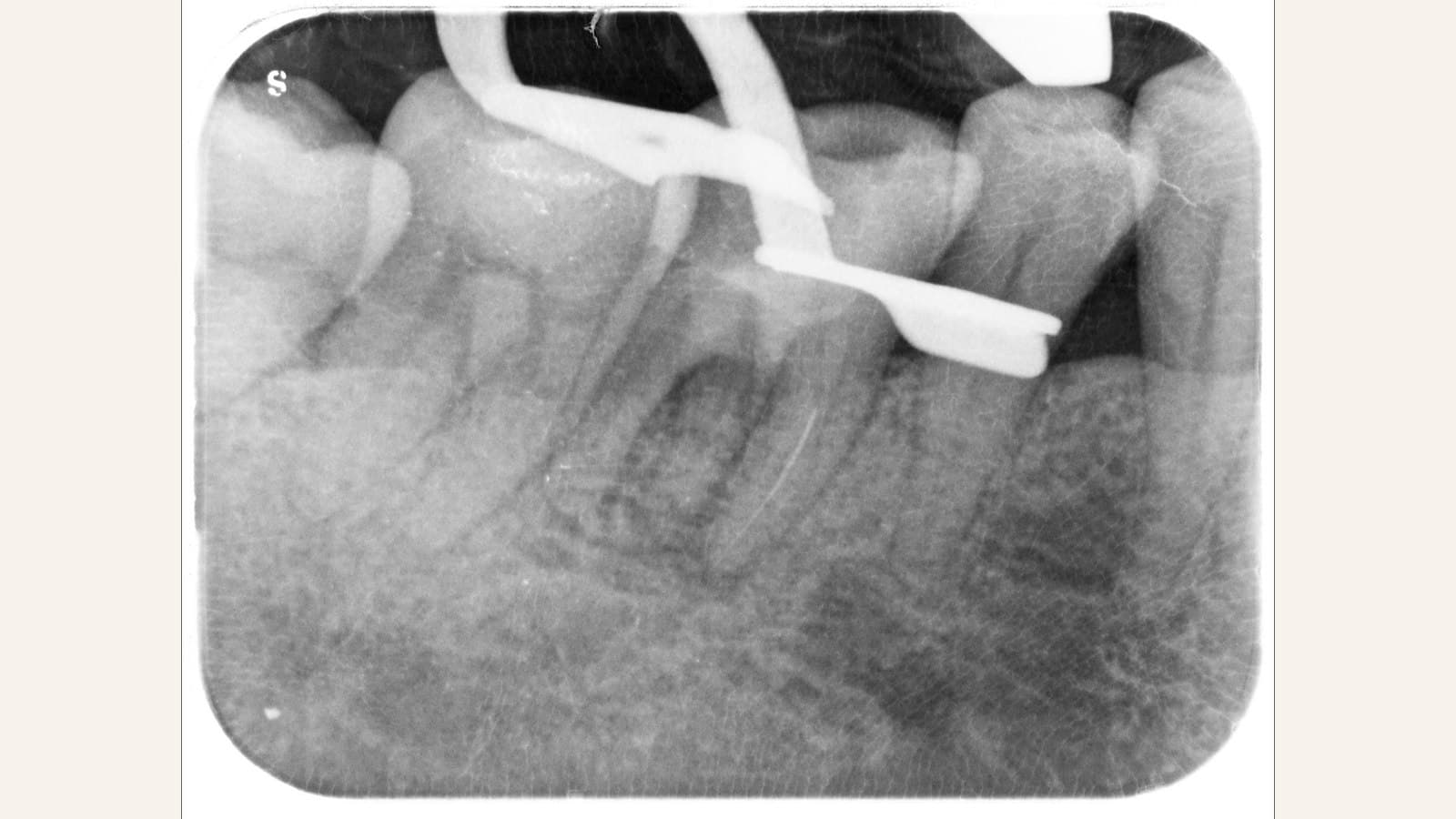
- Imaging — X-rays help assess the root, bone, decay and infection, but fine cracks do not always show clearly on standard X-rays, so imaging is interpreted alongside the clinical tests.
- Comparing treatment options — explaining how much natural tooth each option preserves, its expected durability, the number of visits, limitations and cost.
"I've Chipped a Front Tooth — What Now?"
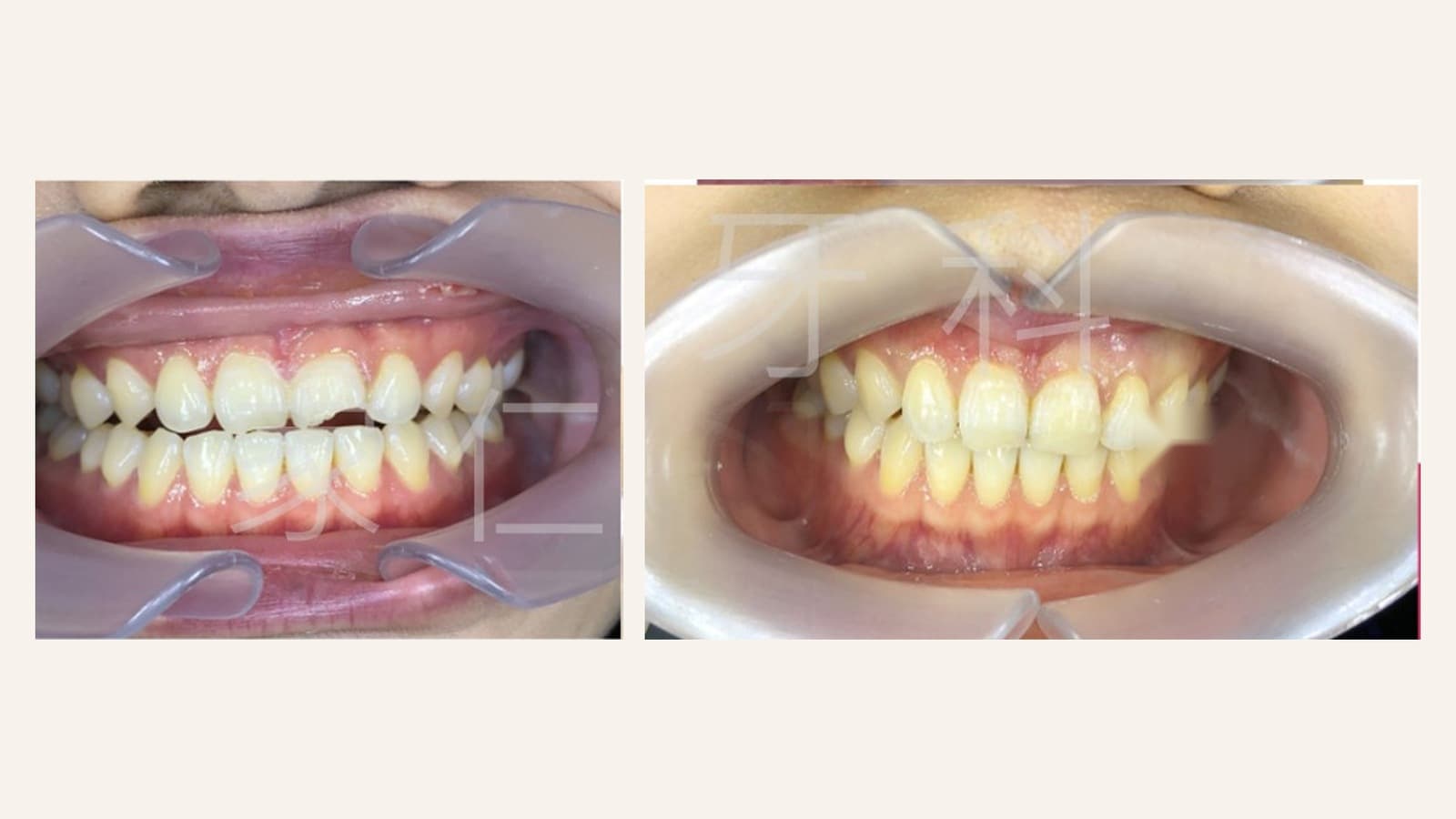
With a chipped front tooth, the first question patients ask is often not about pain but: "will it show?" Where the defect is small and the tooth shade and bite are favourable, a composite resin repair can look very natural — though the final result still depends on the position of the chip, material thickness, shade matching and how the tooth is used afterwards.
Accidental Knock, Small Defect, Normal Bite — Composite Resin
This is the ideal scenario. With proper layering technique and well-matched shades, the repaired tooth can look remarkably natural.
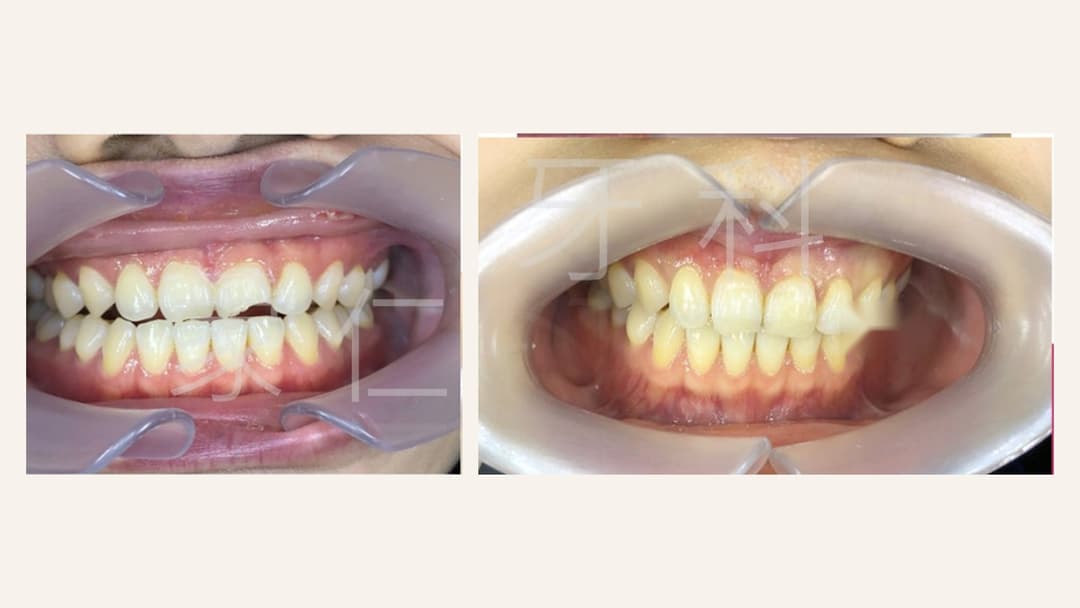
Larger chips can also be treated with composite resin, but the demands on technique and materials are considerably higher.
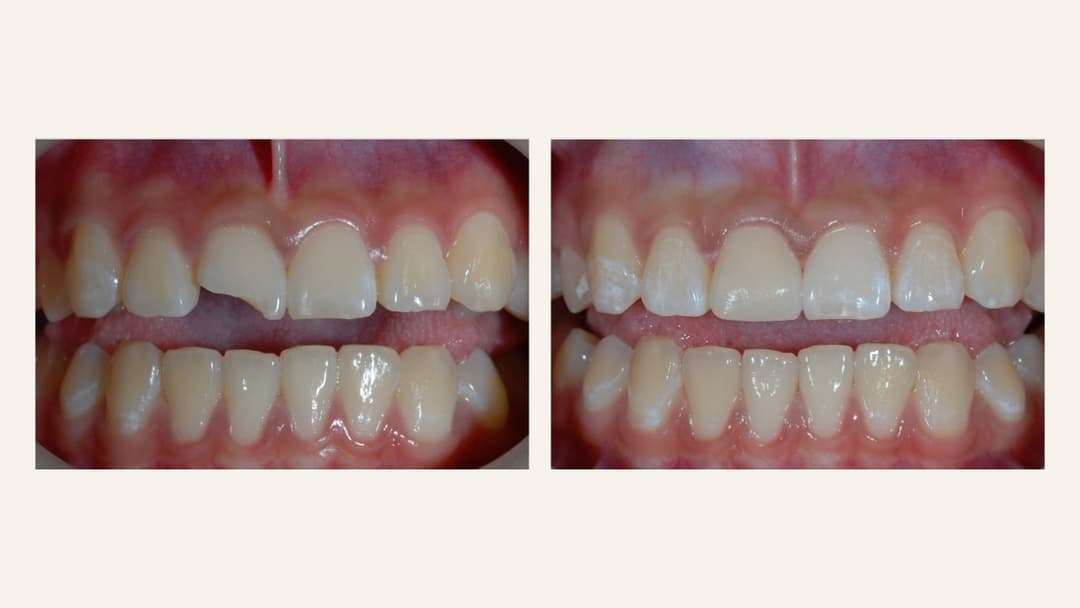
One thing should be said plainly, though. However finely it is polished, composite resin is still not natural enamel — its strength, wear resistance and stain resistance are all lower than natural tooth. After repair you still need to mind your diet and oral habits, and the restoration may need redoing in future due to marginal staining or wear. That is not a treatment failure; it is a property of the material. For the differences between filling materials, see our guide to filling materials.
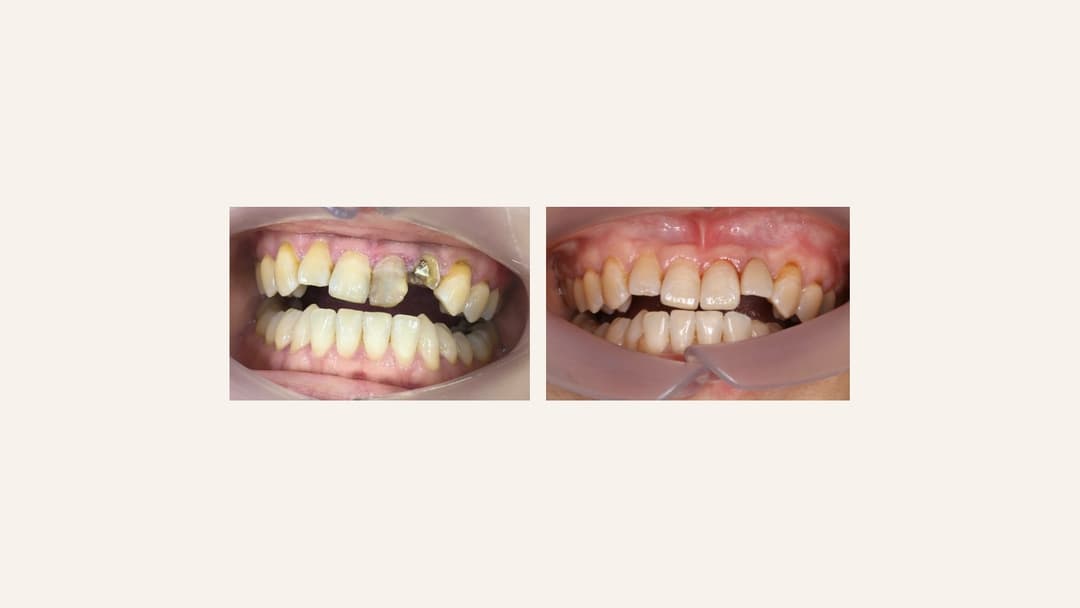
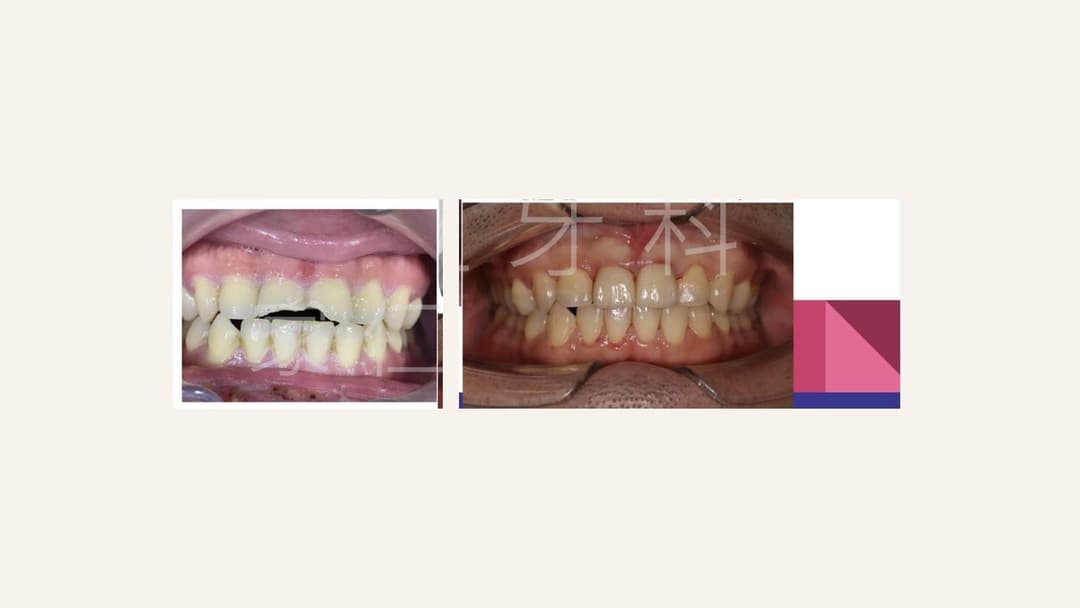
Larger Defect, a Cracked Tooth, or Heavy Bite Forces — Crown or Inlay
Two common misconceptions are worth clearing up first: a large chip does not automatically mean a crown, and having a crown does not automatically mean having a post.
Some chipped teeth are not the result of a single impact. Over years of use, the tooth accumulates fine hidden cracks, and one particular bite becomes the final straw. The structure of such a tooth is already weakened, and composite resin alone may not last as it should.
Clinically, the order of consideration usually starts conservative:
- Composite resin — small defect, tooth walls still intact.
- Inlay or onlay — moderate defect with enough healthy tooth to preserve. This option is often overlooked, yet it retains more natural tooth than a crown.
- Crown — extensive damage, weakened cusps, or a need to distribute bite forces across the whole tooth.
- Post — only used when the tooth has completed root canal treatment and not enough structure remains to retain a crown.
On posts, one more point is worth knowing: a post provides retention, giving the rebuilt core something to hold onto — it does not strengthen the root itself. In other words, a post is not a reinforcing part that makes the tooth "more solid"; if it can be avoided, it should be.
Where a crown is the appropriate choice, it covers the tooth's main load-bearing surfaces and distributes bite forces rather than concentrating them on the weakened area. Different ceramics and other crown materials vary in strength, aesthetics, thickness and wear characteristics, and the dentist will choose based on the tooth's position, remaining structure, bite and grinding habits. If full-coverage restoration is needed after assessment, see our crown and bridge services.
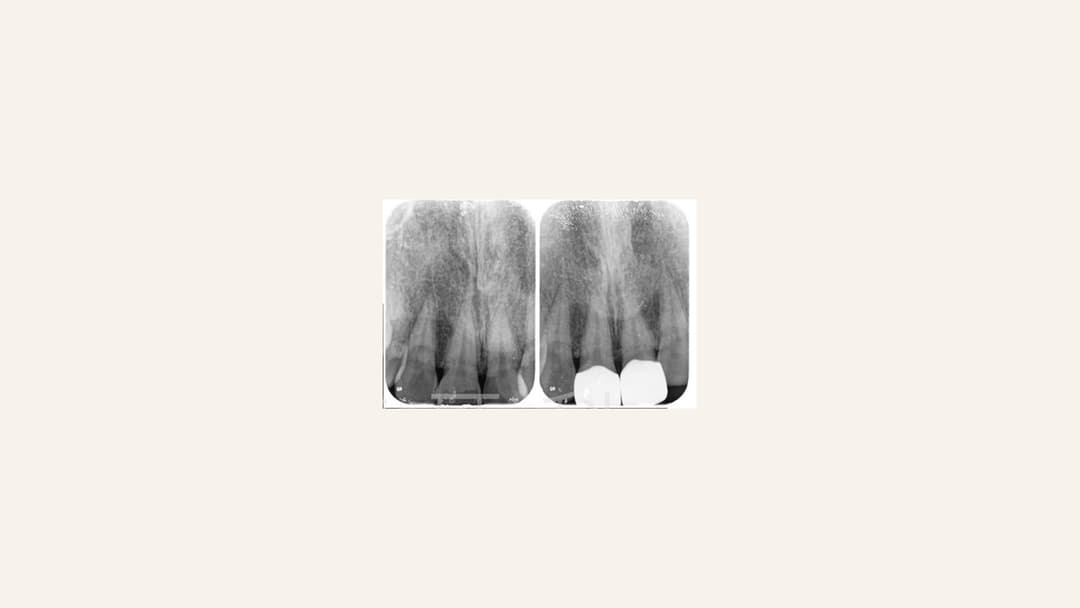
When the Fracture Extends into the Root — the Tooth May Not Be Saveable
This is the minority of cases, but it does happen. When a crack extends down into the root, the tooth may no longer offer a stable foundation for restoration; the depth of the crack, the periodontal condition, the state of the pulp and the remaining tooth structure all have to be weighed to decide whether the tooth can still be kept.
If the tooth ultimately cannot be saved, immediate implant placement can be assessed after extraction — but this is not a routine option for every chipped-tooth case. Suitability depends on bone quality, infection control, the gum and soft tissues, the extent of the fracture and the bite; where conditions are not ideal, allowing the tissues to heal first and planning the replacement afterwards is often the sounder approach. See our dental implant service and assessment guide for details.
Already Chipped a Tooth? Book an Examination First
Open seven days a week, with earlier slots available for urgent cases
Some Minor Chips Are Better Not Filled Straight Away
"It's chipped, so just fill it back in, right?" In most cases, yes. But there is one type of case — and it is not rare — where that is the wrong move.
If the chip is extremely minor and the tooth sits within an unbalanced bite, simply filling the defect places the restoration into a position under constant, poorly directed load. The usual result is a restoration that fractures again and again, while the real problem is never addressed.
Managing these cases is usually far simpler than patients expect. Common approaches include:
- Smoothing — polishing sharp edges smooth, with no filling material at all.
- Small localised repair — treating only the areas affecting appearance or causing sensitivity.
- Occlusal adjustment — adjusting a few premature contact points so bite forces redistribute.
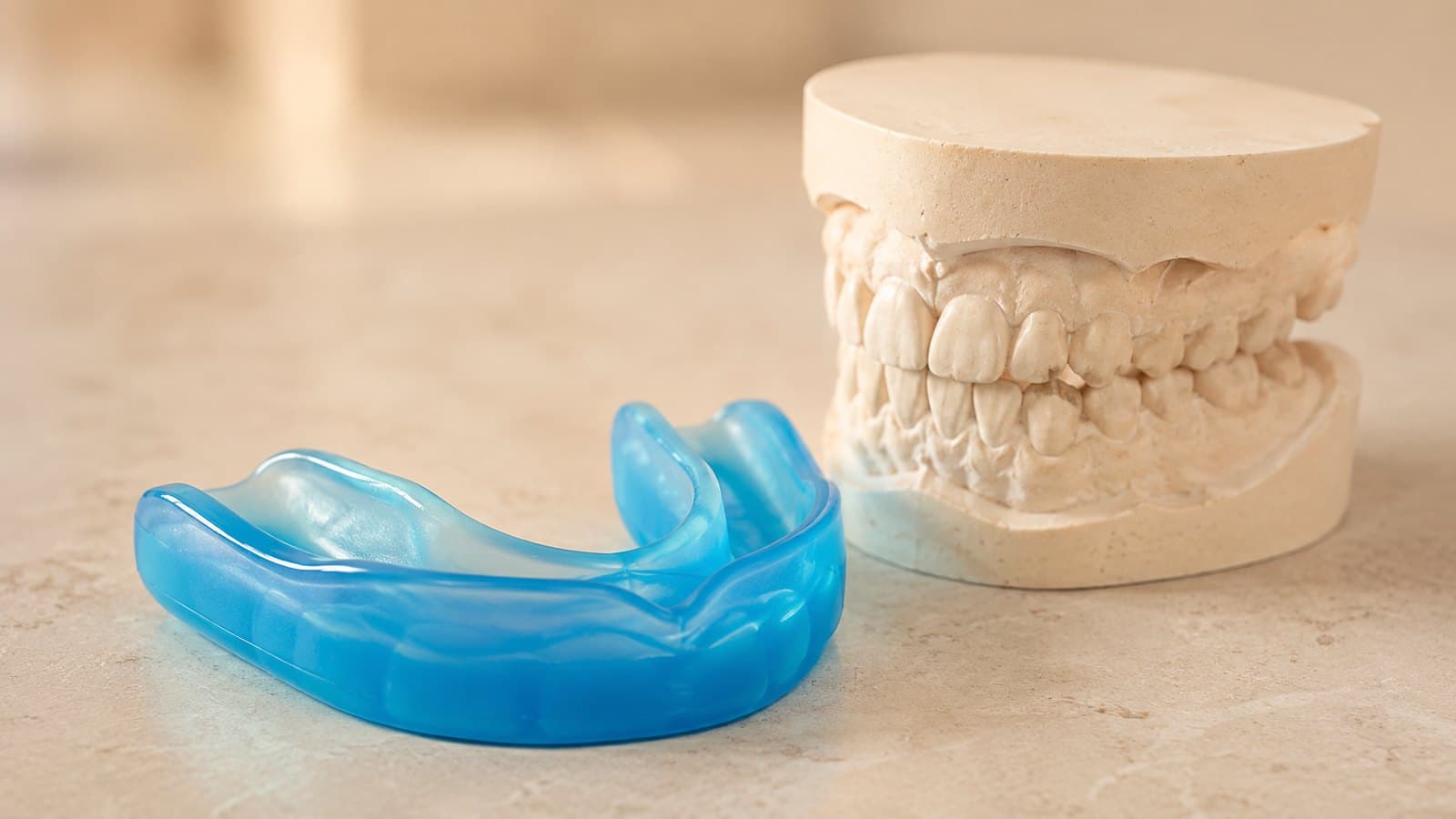
- A night guard — for patients who grind, protection often matters more than the filling itself.
- Regular monitoring — recording the current state with photos or models and comparing the rate of change at review visits.
For most of these cases, that is as far as it needs to go.
Only when wear is already widespread across multiple teeth, and the bite height itself has changed, does the conversation move to the level of full-mouth rehabilitation and occlusal reconstruction. Among chipped-tooth cases, this is a small minority.
A minor chip is not something to ignore entirely, either. If the bite pattern or a grinding habit keeps loading the tooth, the dentist may first control the risk with occlusal adjustment, a night guard or regular records, rather than moving straight to more extensive restoration.
"I've Broken a Molar — What Now?"
With a broken molar, the most common question is: "does it definitely need a crown?" The answer is no — back teeth actually have more options than front teeth.
Back teeth usually bear higher chewing forces, so the same-sized defect makes different demands on material thickness and remaining tooth structure. Depending on the extent of the damage: composite resin suits smaller defects where the remaining walls and bite are favourable; an inlay is typically used where the defect sits between the cusps and no cusp needs covering; an onlay can cover one or more weakened cusps while preserving usable healthy tooth; and a crown is generally reserved for extensive damage, clearly weakened cusps, or where full coverage is needed to distribute bite forces. Having had root canal treatment is only one factor in the assessment — it does not by itself mean a crown is mandatory.
Inlays and onlays are made outside the mouth and then bonded in place; in suitable cases they can rebuild the tooth's shape and contact points with good accuracy while preserving more natural tooth than a full crown. Whether they are more suitable than a direct resin repair still depends on the extent of the defect, moisture control, material thickness and the bite. For how the four options differ, see fillings vs inlays vs onlays vs crowns.
With Very Heavy Bite Forces, the Material Choice Changes
Even once a crown is decided on, the material still has to match the bite. For patients with particularly heavy bite forces or severe grinding, the dentist will weigh the tooth's position, remaining structure, restoration thickness, aesthetic requirements and the effect on opposing teeth, considering high-strength ceramics (such as zirconia), porcelain-fused-to-metal or other materials — and may also recommend a night guard. No single crown material suits every chipped-tooth case. For the differences between crown materials, see choosing between crown materials.
How Much Does Chipped Tooth Repair Cost in Hong Kong?
Direct answer: based on Home Dental Centre's current published fees, a minor chip that is assessed as suitable for composite resin repair starts from HK$850. As a general budgeting reference, publicly listed composite filling prices in Hong Kong range from roughly HK$600 to HK$3,000. The actual repair cost depends on the position and depth of the defect, the number of surfaces or cusps involved, the condition of the pulp, the bite and the restorative material; if an inlay, onlay, crown or root canal treatment is needed, those are costed separately according to the actual treatment plan.
The figures below are not a "Hong Kong average" — they are a general reference compiled from multiple publicly viewable Hong Kong price lists as at 2 August 2026. Materials, inclusions, practitioner experience and case complexity differ between services, and some price lists show no last-updated date, so comparing lowest numbers alone is unwise.
| Possible treatment | Publicly listed HK price reference | Home Dental Centre published fee | What to check when comparing |
|---|---|---|---|
| Smoothing / monitoring | Usually requires an examination fee plus X-rays as needed | Explained after clinical examination | Whether only enamel is involved; whether occlusal adjustment or regular records are needed |
| Composite resin filling | Approx. HK$600–3,000 | from HK$850 | Tooth position, size of the defect, number of surfaces, shade matching for front teeth, occlusal adjustment |
| Inlay / onlay | Few standalone published prices in Hong Kong; usually quoted by material and complexity | Quoted after examination by material and complexity | Material, number of cusps covered, digital fabrication and laboratory fees all affect the quote |
| Crown | Approx. HK$6,000–12,000 per tooth | from HK$6,500 | When comparing quotes between clinics, confirm whether core build-up, post, temporary crown and laboratory fees are included |
| Root canal treatment | Approx. HK$4,000–25,000 per tooth | from HK$7,000 | Front teeth and molars have different numbers of canals; retreatment or microscope work can cost more, and the final inlay or crown is usually charged separately |
| Routine (non-wisdom) extraction | Approx. HK$600–1,500 | from HK$1,200 | A fractured root, difficult position or surgical approach changes the fee |
| Single-tooth implant replacement | Approx. HK$13,000–45,000 | from HK$22,000 | When comparing quotes between clinics, confirm whether the price covers surgery only or the implant, abutment and crown; CT, bone grafting, temporary teeth and reviews may be charged separately |
How to read these figures: for a small chipped corner with a healthy pulp, sound remaining structure and a favourable bite, a conservative resin repair is usually considered first. Where a molar has lost one or more cusps, or the remaining walls are too thin, an inlay, onlay or crown costs more but exists to rebuild the tooth's shape and distribute bite forces. If the pulp is inflamed or infected, root canal treatment and the final restoration are usually costed separately. If examination shows the pulp is affected, see our root canal treatment service.
About these prices: Before accepting treatment, confirm whether the fee includes examination, X-rays or CT, anaesthesia, materials, laboratory fees, posts, temporary restorations and review visits. Actual fees and treatment time depend on the complexity of your case and the treating dentist's level of training. After a clinical assessment our team will explain your condition, the fee and the time involved, so you can decide what is right for you.
How these prices were compiled
Data reviewed on 2 August 2026. This article draws on multiple publicly viewable Hong Kong price lists, organised by treatment type, as a general budgeting reference only; prices for different materials, complexity levels and inclusions have not been treated as the same service.
Why You Shouldn't Put It Off
Conservative management does not mean skipping the examination. A very minor chipped corner may only need smoothing or monitoring — but whether only enamel is involved, whether a crack runs deeper, and whether the pulp is affected usually cannot be distinguished without being examined.
Exposed dentine can cause sensitivity to hot and cold, but symptoms vary between people, and some cracks cause no pain at all in the early stages. If a defect or crack lets bacteria approach the pulp, inflammation or infection can follow; and if a crack keeps propagating under bite forces, a tooth that could have been managed conservatively may come to need more complex restoration. The point of an early examination is to keep more treatment options open while circumstances allow — though it cannot guarantee that every case will avoid root canal treatment or extraction.
Treat a Chipped Tooth Early, Before the Damage Spreads
Even a chipped tooth that doesn't hurt yet is no guarantee that the pulp and internal structure are unaffected. If the defect keeps taking bite forces, an existing crack can gradually extend — turning a case that could have been directly filled into one needing an inlay, onlay or crown later on. If you have a chipped front tooth or broken molar, an old filling has come away, or you feel a sharp pain when biting, arrange a dental examination as early as you can.
If you experience a chipped tooth, a lost filling or a sharp pain on biting, the Home Dental Centre dental team will assess whether the natural tooth can be saved — based on the depth of the defect, the remaining tooth structure, the pulp response and the bite — and explain the available options, number of visits and costs. To ask about chipped tooth filling or repair costs, book an examination or message the team on WhatsApp below.
Why Choose Home Dental Centre for a Chipped Tooth?
- A team of 31 dentists — including dentists focused on restorative dentistry and endodontics, so follow-up can be matched to the depth of the defect and the state of the pulp.
- CBCT and digital assessment — helping evaluate cracks, roots and bone before comparing conservative and more comprehensive options.
- Joint cross-specialty assessment — where root canal, periodontal or implant assessment is involved, referral happens within the same team, with no new waiting list.
- Transparent fees — treatment options and associated costs are explained clearly after examination and diagnosis.
- Open seven days a week — earlier slots for chipped-tooth emergencies, with no public hospital waiting list.
Medical References
The general clinical principles in this article draw on the following professional sources; actual diagnosis and treatment must be decided by a dentist for each individual case:
Medical information notice: this article provides general dental health information and is not a substitute for an in-person examination, pulp testing, bite assessment or imaging. If you have severe pain, a loose or displaced tooth, persistent bleeding, facial swelling, fever, or suspect the pulp is exposed, seek care promptly.