
Key Takeaways
- Four main options: removable dentures, bridges, implants and implant overdentures — none is automatically "the" answer
- A loose, uncomfortable denture can usually be improved: adjustment, remake, or implants to anchor it
- Full-mouth tooth loss does not automatically mean All-on-4 — complete dentures and implant overdentures are equally legitimate options
- Treatment can be staged: deal first with what affects life most, and take the rest step by step
There is no one right answer to tooth replacement — removable dentures, bridges, implants and implant overdentures each suit different people. This page lays out the differences so you and your family can choose the path that fits health, mouth and budget.
Not sure which situation applies to you or your parent? WhatsApp us to enquire or book, or call 3956 9387.
What happens if missing teeth are left alone?
The most direct impact is chewing: the fewer opposing pairs of teeth, the narrower the food choices, and research links reduced chewing function with poorer nutritional status. Neighbouring teeth also drift and tilt into the gap and opposing teeth over-erupt, making later restoration more complex, while the jawbone in the gap gradually resorbs. Even if major restoration is not urgent, an early assessment at least maps out the options.
The four options at a glance
| Removable denture | Bridge | Implant | Implant overdenture | |
|---|---|---|---|---|
| Surgery needed | No | No | Yes | Yes (a small number of implants) |
| Effect on neighbouring teeth | Clasps rest on them | Both neighbours trimmed down | None | None |
| Stability | Lower, may loosen | Fixed | Fixed | Much more stable than a conventional denture |
| Removal for cleaning | Daily | Not removed | Not removed | Daily |
| Bone requirement | Low | Low | Higher | Moderate (fewer implants) |
| Medical requirement | Low | Low | Needs assessment | Needs assessment (smaller surgery) |
| Complexity | Low | Medium | Higher | Medium to higher |
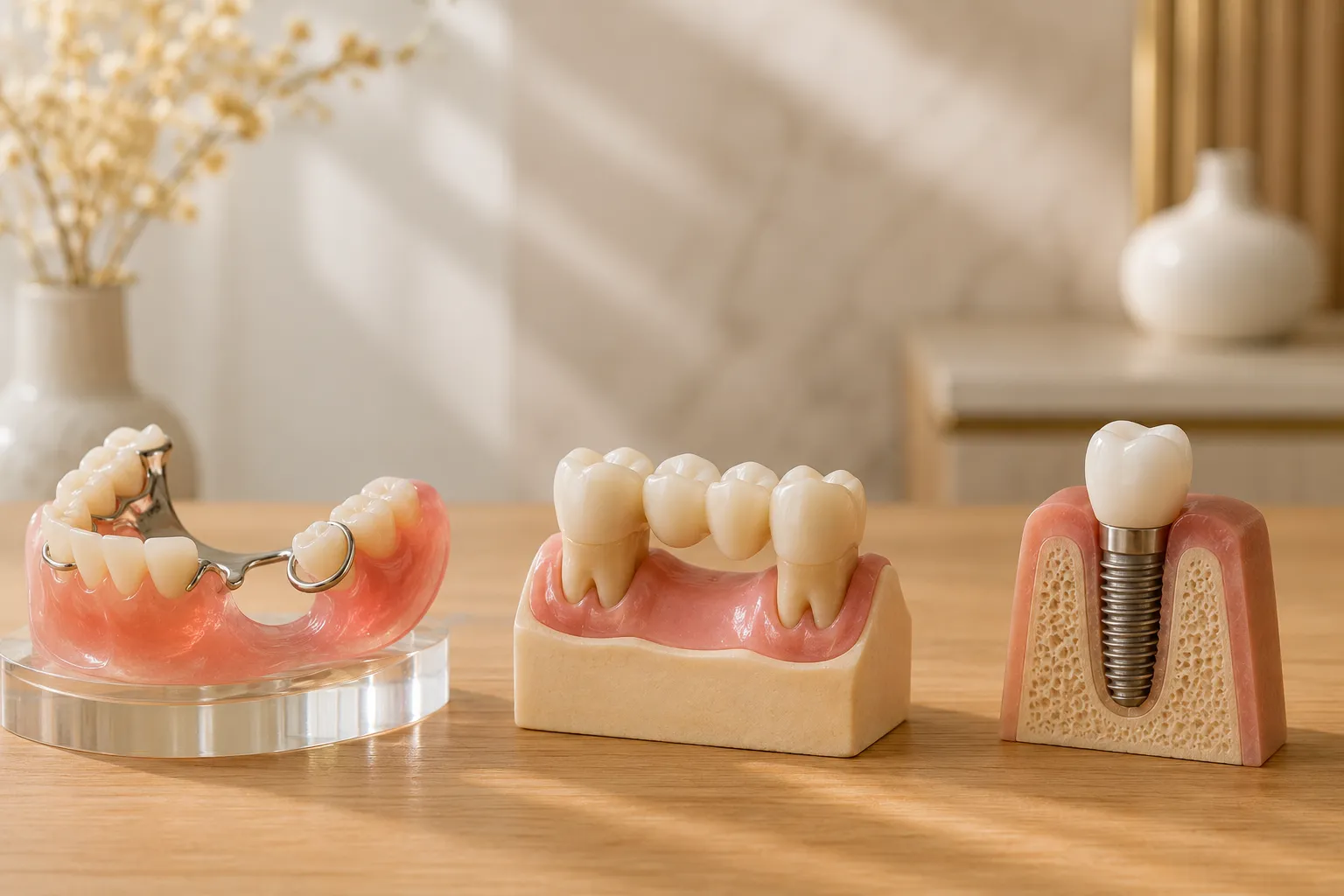
Removable dentures: a starting point — but don't just put up with a bad one
Removable dentures need no surgery and suit seniors with many missing teeth, those not currently fit for surgery, or those who prefer a simpler solution first. A well-made denture should feel secure and let you eat. If a denture is constantly loose or painful, don't simply endure it — adjustment or a remake often helps, and wearing an ill-fitting denture long-term worsens the gums and bone underneath. Related services: Dentures and crowns, Restorative dentistry
For a fuller look at what separates a well-made denture from one you merely tolerate — and the problems an ill-fitting denture can cause — see removable dentures: types, fabrication and pricing; for a comparison of denture designs, see types of dentures and what to know before fitting.
Whether it is a partial denture or a complete denture, fit and fabrication quality directly affect chewing, comfort and long-term oral health.
Not sure which situation applies to you or your parent? WhatsApp us to enquire or book, or call 3956 9387.
Bridges: fixed, but ask one question first
A bridge fixes an artificial tooth to the teeth on either side of the gap — nothing to remove, natural feel. The question to weigh: those neighbouring teeth must be trimmed down to carry the bridge. If they are healthy and untouched, consider whether that trade-off is worth it; if they already carry crowns or large fillings, a bridge can be an excellent choice. The supporting teeth also need sound gum health.
Implants: an option for seniors too?
Yes — age alone is not an exclusion; what matters is general health, bone volume and gum foundations. Implants leave neighbouring teeth untouched, are stable, and feel closest to natural teeth. Patients with chronic conditions (diabetes, blood thinners) are assessed and coordinated first — see dental safety assessment for seniors. Implant service details: Dental implants; for what drives implant costs, see dental implant pricing in Hong Kong.
Not sure which situation applies to you or your parent? WhatsApp us to enquire or book, or call 3956 9387.
Implant overdentures: the middle option many seniors don't know about
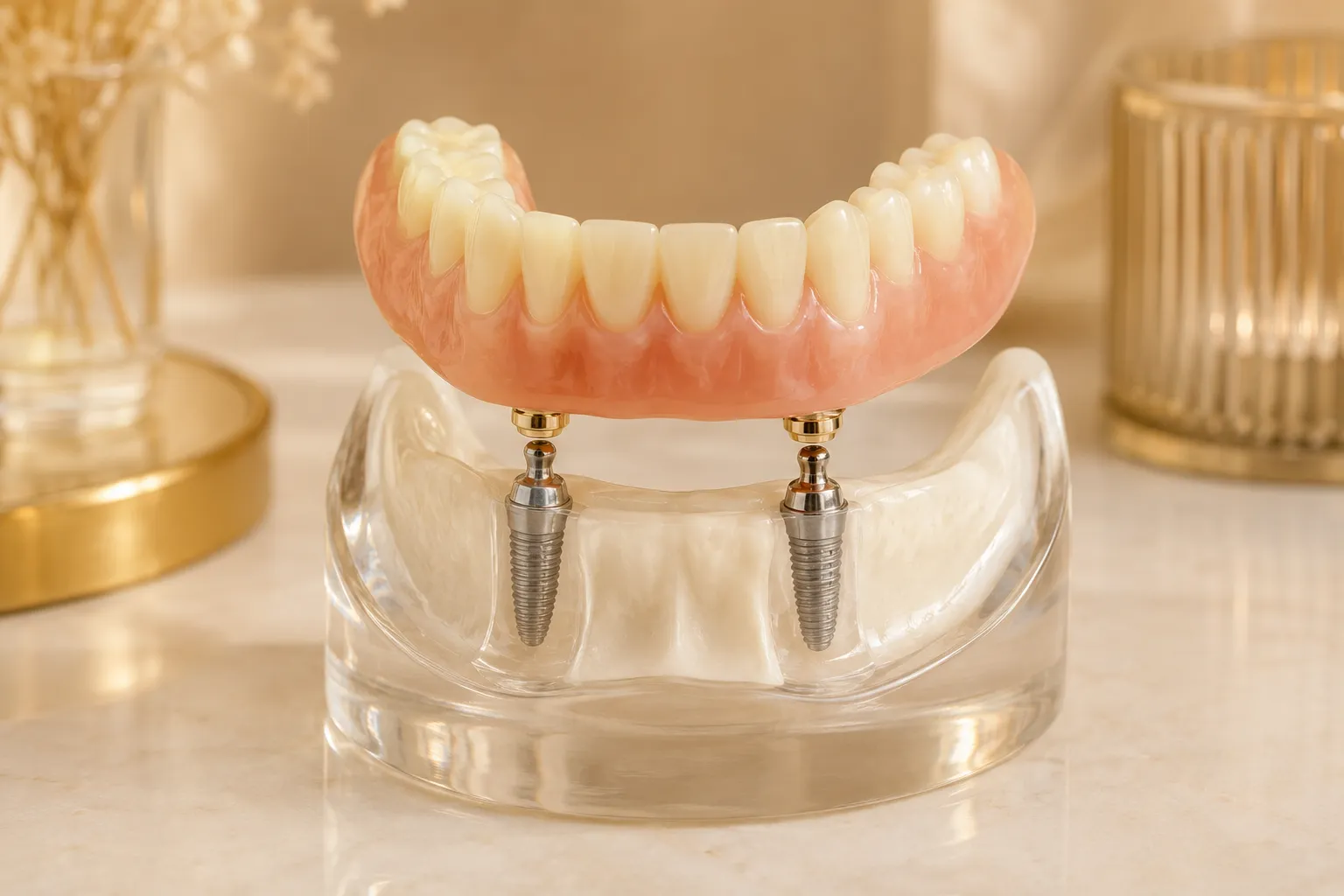
An implant overdenture sits between a conventional denture and full fixed implant work: a small number of implants (often from two in the lower jaw) act as anchors that the denture clips onto — far more stable for speaking and eating, yet still removable for easy cleaning. The surgery is smaller than fixed full-arch rehabilitation, bone requirements are relatively lower, and the cost sits below fixed full-arch options — well suited to seniors who already wear a denture but find it loose.
No teeth left at all — what then?
There are three main directions for a completely edentulous mouth, and the biggest is not automatically the right one:
- Complete removable dentures — no surgery; suits those not fit for or not wanting surgery
- Implant overdentures — a few implants transform stability; a strong middle option
- Fixed full-mouth rehabilitation (including All-on-4-type solutions) — where health and bone allow: fixed, nothing to remove, function closest to natural teeth. All-on-4 is one full-arch approach among several; suitability is decided at assessment
Full-mouth rehabilitation involves several specialties working together — see restorative dentistry and oral and maxillofacial surgery for how these are handled.
You don't have to do everything at once
The planning principle for seniors: treat first what most affects health and daily life (pain, infection, inability to eat), and stage the rest. After the first visit the dentist explains clearly what should be treated first, what can be staged, and the fees of each option — so you and your family can decide by priority and budget, with questions welcome any time.
Why choose Home Dental Centre
- Prosthodontic, periodontal and oral and maxillofacial expertise within one team, assessing and planning treatment together, which reduces the need to coordinate care across different clinics
- The full range of options in-house, from removable dentures to fixed full-mouth rehabilitation — advice starts from your situation, not from one procedure
- Options, priorities and fees explained clearly — no pressure to decide on the spot
- Following assessment, surgical cases can be treated under sedation at the separately licensed dental Day Procedure Centre (DPC) in Tsuen Wan, monitored by a registered specialist anaesthesiologist; open seven days at Causeway Bay and Tsuen Wan
Not sure which option fits you or your parent? WhatsApp us or call 3956 9387.
Key sources
- Department of Health, Hong Kong SAR Government — Oral Health Survey 2021: official publication
Last updated: August 2026