Severe tooth loss or extensive dental damage affects not only facial aesthetics, but also chewing function and personal confidence. With modern advancements in implant dentistry, the All-on-4 full arch rehabilitation technique provides a scientifically precise solution that restores an entire fixed dentition with fewer implants and reduced surgical burden.
All-on-4 is a full-arch approach in which four implants support a whole fixed bridge, for people missing all or nearly all of their teeth in a jaw who do not want removable dentures. Treatment usually runs in four steps: X-ray/CT and health assessment → four implants placed, with a fixed temporary bridge the same day or soon after where conditions allow → about 3–6 months for the implants to fuse with the bone → the final fixed bridge, followed by regular reviews. A systematic review found high short- to medium-term implant survival, but long-term high-quality evidence is still limited, and the most common problem was fracture of the bridge's acrylic[1] — so reviews and maintenance matter as much as the surgery.
New to All-on-4? See what All-on-4 is and how it differs from traditional implants, or read a real upper and lower All-on-4 case.
Below, we present a complete clinical case journey to illustrate the rigor, planning, and long-term value behind this treatment.
Our All-on-4 series: what do you want to know first?
- What All-on-4 is and how it differs from single implants: All-on-4 vs traditional implants
- Costs, process and timeline: this article
- A real case: from failing teeth to fixed teeth the same day: Upper and lower All-on-4 immediate implant case
1. Understanding All-on-4: Biomechanics Meets Bone Structure
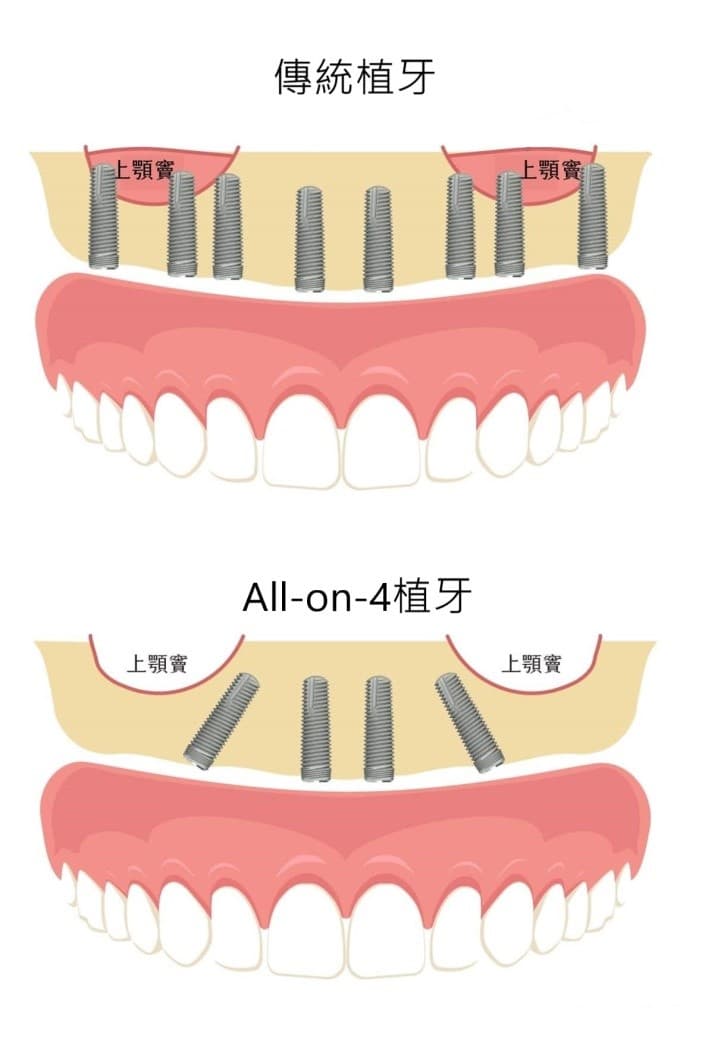
The All-on-4 concept is a biomechanically engineered approach in which four strategically angled implants are placed into the jawbone to support a full fixed dental bridge.
This technique is particularly beneficial for patients with limited bone volume, as it often avoids the need for complex procedures such as bone grafting or sinus lift surgery.
Compared with traditional full-mouth implant rehabilitation requiring six to eight implants, All-on-4 can reduce overall cost by approximately one-third to one-half, while significantly shortening treatment time and physiological stress.
2. Clinical Case Journey: A Step-by-Step Restoration Process
Full arch rehabilitation is never a single-step procedure—it is a carefully staged medical process.
a. Digital Pre-Surgical Assessment
Successful outcomes begin with accurate diagnostics. We perform a full panoramic X-ray evaluation to assess bone volume, nerve positioning, and oral health conditions, allowing for a fully individualized treatment plan.

b. Healing Phase with Temporary Fixed Prosthesis
After implant placement, the gum tissue and bone require approximately 3 to 6 months for osseointegration.
During this period, patients are fitted with a temporary fixed prosthesis, ensuring continued chewing function, aesthetics, and social confidence.

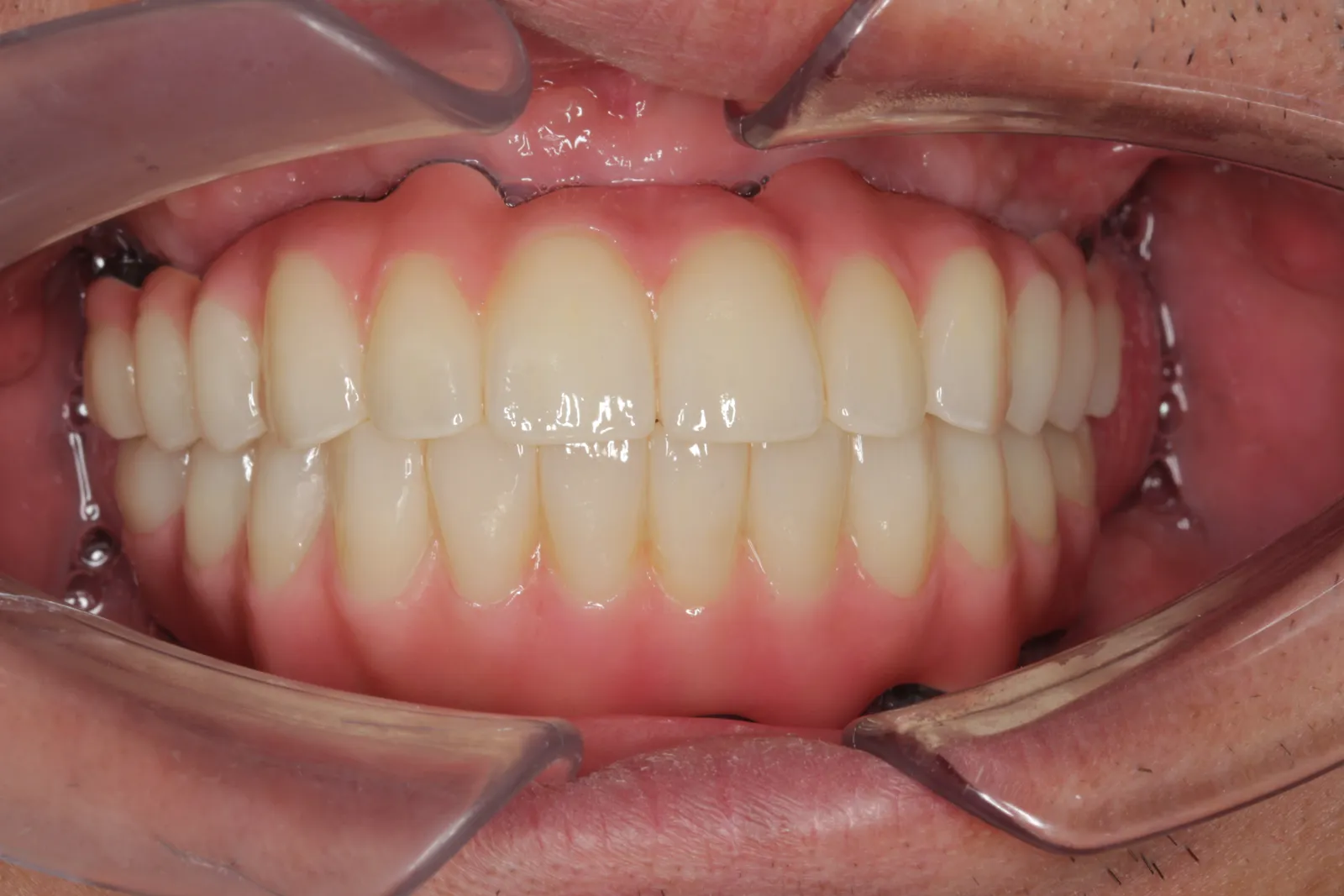
c. Final Restoration: Metal-Ceramic Fixed Bridge
Once implant integration is confirmed, the final restoration is delivered in the form of a metal-ceramic fixed bridge.
This prosthesis combines:
-
An internal metal framework for structural strength and bite resistance
-
An outer ceramic layer that recreates natural translucency and lifelike aesthetics

d. Treatment Outcome
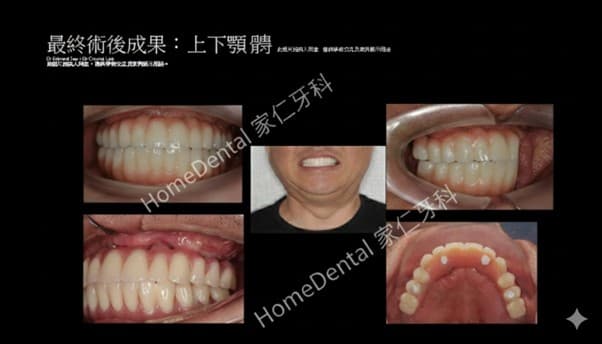
The final result demonstrates a natural smile reconstruction and optimized occlusal function, restoring both comfort and confidence.

3. Cost and Value: Understanding the Investment in Long-Term Health
Full mouth rehabilitation is a significant healthcare investment.
In Hong Kong, the typical cost range for All-on-4 full arch implants is:
From HKD $80,000 per arch, or HKD $150,000 for a full mouth
Cost differences depend on:
-
Material selection: acrylic versus durable metal-ceramic solutions
-
Clinical complexity: extractions, infection management, bone limitations
-
Professional expertise: surgeon experience and qualifications
4. Ensuring Long-Term Success
When choosing a clinic, patients should look beyond price and focus on long-term medical reliability.
High-quality implant centres provide:
-
Transparent material explanations
-
Documented real clinical cases (Before & After)
-
Long-term follow-up support
Successful implant outcomes require strong patient–doctor collaboration:
-
Professional maintenance every 6 months
-
Strict daily oral hygiene to prevent peri-implantitis
-
Continuity of care with a stable medical team
All-on-4 full-mouth implants are a major course of treatment, and the pre-operative assessment, integration period and final restoration all need careful planning. To see how implant assessment and treatment are carried out, refer to our dental implant service.
How are All-on-4 fees calculated? What is included and what is extra
| Single arch (upper or lower) | Both arches | |
|---|---|---|
| Starting fee | From HK$80,000 | From HK$150,000 |
| Usually included | Four implants per arch (eight for both) and surgery, a fixed temporary bridge, the final fixed bridge in the chosen material, and reviews during treatment | |
| Extra, depending on the case | Removal of remaining teeth, bone grafting or a sinus lift, CBCT imaging, sedation or anaesthesia at our licensed Day Procedure Centre, and bridge material upgrades such as full ceramic | |
| After completion | Regular professional maintenance; later bridge or component replacement charged as needed | |
This is only how the fee is made up. Home Dental Centre sets out the procedures and fees for your plan after a clinical and imaging assessment, and starts only with your agreement. For how a single implant is priced, see our implant fee promise; for Hong Kong market prices, see our Hong Kong implant price guide.
Which material for the final bridge?
| Material | Characteristics | Watch out for |
|---|---|---|
| Acrylic bridge | Light and lower cost; often used as the temporary or transitional bridge | Wears or chips more easily with long-term use and may need replacing |
| Metal framework with ceramic | The metal core provides strength and the ceramic layer recreates the look of teeth — the option used in this case | Small chips can be repaired; larger damage means remaking the bridge |
| Full ceramic (zirconia) bridge | Natural appearance and wear-resistant | Higher cost; a night guard is needed with a heavy bite or grinding |
The choice depends on the opposing teeth, bite force, appearance and budget, and is recommended by the prosthodontic dentist for each case.
What are the full-arch options? Alternatives to All-on-4
| Option | Fixed / removable | Implants per arch | Bone needed | Suits |
|---|---|---|---|---|
| Full denture | Removable | 0 | None | Those who do not want or cannot have surgery, or with a limited budget; lower stability and chewing power |
| Implant overdenture | Removable (clips onto implants) | About 2–4 | Lower | Those who want more stability than a conventional denture and accept daily removal for cleaning |
| All-on-4 fixed bridge | Fixed | 4 (the back two tilted) | Moderate: uses bone at the front of the jaw, often avoiding grafts | All or nearly all teeth missing; fixed teeth and a shorter treatment wanted |
| All-on-6 fixed bridge | Fixed | 6 | Higher: enough bone at the back, or grafting / a sinus lift first | Good bone volume and a wish for more implants to spread the bite force |
| Individual implants | Fixed | 8 or more | Highest | Plenty of bone and the closest match to natural teeth; the longest and most costly route |
All-on-4 and All-on-6 are not simply better or worse than each other: more implants mean less load on each one, but higher demands on bone and budget. The bone shown on CBCT, the bite force from the opposing teeth and the budget are what the dentist weighs up. For a comparison of implant approaches, see types of dental implant treatment.
How long does All-on-4 take from assessment to finish?
| Stage | Approximate time | What happens |
|---|---|---|
| 1. Assessment | 1–2 visits | CT scan of the bone, examination, medical history and medicines; any gum disease or decay treated first |
| 2. Surgery and temporary bridge | Surgery day | Teeth that cannot be saved are removed and four implants placed; if the implants are stable enough, a fixed temporary bridge is fitted the same day or soon after |
| 3. Healing (osseointegration) | About 3–6 months | Mainly soft food, no hard biting; reviews to check healing and the implants |
| 4. Final fixed bridge | Several visits | Impressions or intraoral scan, try-in, fitting and bite adjustment |
| 5. Long-term maintenance | Usually every 3–6 months | Professional cleaning, screw and bite checks, X-rays when needed |
Times vary from case to case. For how All-on-4 compares with individual implants, see All-on-4 vs traditional implants; for a real upper-and-lower example, see our All-on-4 full-arch case; for long-term care, see implant lifespan and care.
Wondering whether All-on-4 is right for you?
👉 Book a full-arch implant assessment on WhatsApp (5402 6630)
☎️ Call 3956 9387 (during opening hours)
We see patients in Causeway Bay and Tsuen Wan, and we also have a TST Dental Consultation and Education Centre, by appointment.
References
- Soto-Penaloza D, Zaragozí-Alonso R, Penarrocha-Diago M, Penarrocha-Diago M. The all-on-four treatment concept: Systematic review. Journal of Clinical and Experimental Dentistry, 2017;9(3):e474–e488. (full text)