Many people are afraid of seeing a dentist and the associated discomfort and pain, and some of them are also worried about the cost of dental treatment. As a result, the problem often becomes more and more serious, and finally it takes more time and money to solve the problem completely. The most common example is tooth decay.
Tooth decay cannot be ignored
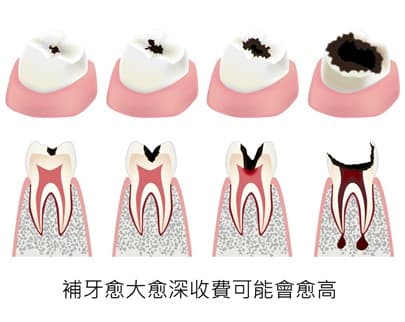
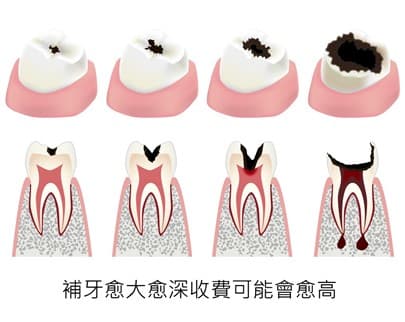
Tooth decay generally progresses from shallow to deep. If you have regular dental checkup with oral X-rays examination, it will be easier to detect tooth decay early. Dentists can perform simple filling treatments and instruct patients on enhanced cleaning with continuous observation.
If you turn a blind eye to the problem, over time, a shallow cavity will turn into a deeper cavity, and even if it can still be repaired, it will be more difficult to repair than a shallow cavity.
Is there a unified standard for comparison?
Different dental centres and clinics may have different treatment charges for each filling case, depending on whether they possess advanced equipment, whether the attending dentist has rich qualifications, whether the materials used are of high quality, and whether the maintenance and follow-up treatments are covered by the charges. Those factors will all affect the final treatment cost.
Four common factors affecting the cost of Filling
Moreover, depending on the patient's dental condition, the treatment cost of fillings for each tooth may also vary. The four most common factors that affect the cost of fillings are as follows:
1. The location of the filling
The more hidden the cavities, the more difficult it is for the dentist to fill the teeth. For example, the interproximal surfaces of the teeth and the molar sites will require higher filling techniques. However, this does not mean that the more obvious the filling position is, the lower the technical requirements will be, because sometimes the more obvious position (for example, the incisor) will have more influence on the patient's appearance, and the better technology is required to fill it as if it has not been filled.
2. The size and depth of the filling
If the filling gets deeper, the doctor may need to "prime" the inside of the tooth, apply some anti-sensitivity or anti-cavity materials, and then fill the tooth layer by layer. If more materials and processes are involved in filling a tooth, the cost will become higher. Beyond the four cost factors, which filling material suits which cavity is the other half of the decision.
3. Materials for fillings
There are many filling materials available on the market, including amalgam (silver powder), composite resin, glass ionomer cement, glass ionomer resin, and ceramic or cast gold inlays. The hardness, wear resistance, aesthetics and cost of various materials are different. Patients can choose according to the condition of tooth decay and the advice of their dentist.

4. Physician's qualifications
Dentistry has different specialties (such as Pediatric Dentistry, Oral and Maxillary Surgery, Periodontics, Prosthetics, etc.), and each speciality also has the relevant master's and specialist's qualifications. The higher the doctor's qualifications are, the higher the treatment cost may be, because the doctor's experience and skills will also be reflected in the treatment cost. Specialists usually have their own unique treatment methods for the more complicated cases, so their charges also partly reflects the difficulty of treatment.
If the tooth has discomfort after a deep filling, the condition persists or the pain worsens, there is a chance that the original decayed part of the tooth is deeply decayed and close to the pulp, causing pulpitis. At this time, the patient should seek a dentist for detailed examination and treatment as soon as possible. The related teeth may need to undergo root canal treatment to solve the root cause.
If you have any questions, please consult your trusted family dentist.
At Home Dental we assess first and quote up front — no chargeable treatment starts without your consent. Our fee transparency commitment →
Filling quotations differ by position, depth and material, so assessment before quotation is the safest approach. To see the assessment and filling process in restorative dentistry, refer to our restorative dental services.