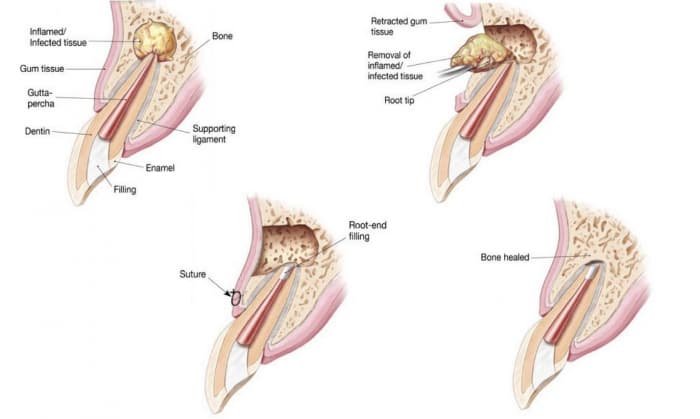
An apicectomy (also known as endodontic surgery, apical surgery, or peri-radicular surgery) is considered as the last resort for apical lesions that cannot be treated by traditional endodontic treatment or endodontic retreatment and is complementary to root canal therapy.
What is apical surgery?
The main goal of apical surgery is to prevent the leakage of bacteria from the root canal into the tissue surrounding the root by removing inflamed or infected necrotic tissue at the root end, followed by the placement of a root filler.
Dentists need to perform apical surgery using an operating microscope, and endodontists with extensive clinical experience are typically responsible for this treatment. During this procedure, an endodontist will open the gum tissue near the tooth to view the underlying bone and remove any inflamed or infected tissue. Over a period of several months, the bone will heal at the end of the root.
When do you need apical surgery?
Since there is good evidence that root canal retreatment has a higher success rate than that of apical surgery, patients are generally recommended for non-surgical root canal retreatment if the initial root canal treatment is unsuccessful. So, when do you need apical surgery? Please check if any of the following applies to your case.
1. The diameter of the cusp lesion is greater than 1cm;
2. There are symptoms related to root canal obstruction (obstruction proved to be non-removable, common endodontic instrument breakage/residual/root canal filled/occluded/disappeared);
3. The root is broken;
4. There has been repeated root canal treatment but problem persists; or
5. The root or bottom of the pulp cavity is perforated and cannot be treated from the pulp cavity.
General Process
The general process of apical resection surgery is as follows:
First, a 3D computed tomography scan (CBCT) needs to be taken, which is helpful for evaluation before apical surgery. After local anesthesia is applied during the operation, the endodontist will use surgical instruments to open the gums on the outermost side of the bone to expose the bone in the operation area, locate the root tip and the scope of inflammation, and use a microscope to completely remove the infected, inflamed or necrotic tissue as well as the apex of the end of the damaged tooth.

When the infected area has been removed, a microscope-assisted examination can be used to carefully examine the root surface for cracks or variations in the congenital structure of the root to determine whether subsequent special treatment is required. With the use of ultrasound and related tools, clean the inside of the root canal at the end of the root.
Finally, with biocompatible material, reverse the opening of the root canal from the apex of the excised tooth to seal the filling. Finally, the doctor will evaluate the size of the bone damage and the different physical conditions of the patient to decide whether it is necessary to place regenerative bone meal or bone collagen. The wound will be sutured, and the stitches will be removed after a follow-up visit about a week later.
The "apical surgery" using a microscope, a high-magnification microscope magnifies the tiny root canal dozens of times, allowing doctors to perform treatment with ultrasonic instruments in a bright and clear environment, and the possibility of failure of microscopic apical surgery is relatively low. That said, as long as it is an operation, there is a risk of failure.

What are the risks?
The risks of apical surgery include:
1. insufficient periodontal support for teeth;
2. the tooth has vertical root fracture;
3. long and wide roots, close to adjacent roots, and inclined towards the top of the mouth (upper teeth) or the bottom of the mouth (lower teeth), making it difficult for the surgeon to operate in the relevant area, so the success rate of surgery is low;
4. the success rate of repeated apical resection is low;
5. potential nerve and sinus problems; and
6. patients with uncontrolled tooth decay.
Careful evaluation is needed!
Physicians will carefully weigh the pros and cons of surgical and non-surgical interventions when assessing the need for apical surgery, that is, considering the possibility of traditional root canal therapy or re-treatment as treatment options, and discussing the pros and cons of all procedures with the patient. Evaluation of apical surgery must be based on careful and thorough clinical and radiological examination.
Root apical surgery is an extremely delicate operation. Whether the doctor is skilled enough in operating the instruments and whether the treatment plan is accurate in grasping the condition or in the face of various emergencies during the apical surgery are all relevant factors to test the doctor's experience and surgical resilience.
Your dentist or endodontist may recommend endodontic surgery because they believe it is the best option for preserving your own natural teeth. Of course, no surgical outcome can be guaranteed. Your endodontist will discuss with you about your chances of success so that you can make an informed decision.
When in doubt, consult your trusted family dentist.